三人、七台电脑。1 到 3 号机跑编码代理,4、5 号机审查,6 号机做 Windows 验证,7 号机负责合入。工单写得很具体:给已支付、尚未发货的订单加改地址接口;状态是 shipped 或 delivered 时必须拒绝,否则仓管可能按新地址再发一次。验收是 pytest -q 为绿。6 号机是常驻验证机,上面有一份持久的仓库副本和虚拟环境。工单里写了:验证某个 SHA 之前,要从那份代码重新安装项目,不要继续用上一单装进去的包。
仓库是 src 布局。真正的实现在 src/shipping/address.py;测试写的是 from shipping.address import update_address,默认并不会把 src/ 放进 sys.path。第一次 pip install . 会把 shipping 拷进虚拟环境的 site-packages。之后如果只做 git checkout 再跑 pytest,解释器导入的仍是那份已经拷进去的文件,不是工作区里正在看的源文件。
更具体一点。Python 启动时,sys.path 的第一项通常是脚本所在目录,或者当前工作目录,然后才是 site-packages。这次仓库里没有顶层的 shipping/ 包,只有 src/shipping/。所以从仓库根目录跑 pytest,解释器在当前目录下找不到 shipping,就会退到虚拟环境里已经安装的那一份。show_imported.py 放在 scripts/ 下面,它的 sys_path0 是 scripts/,同样找不到工作区里的实现。这就是为什么日志里的 imported_file 会指向 .venv/.../site-packages/shipping/address.py,即使你人就站在一份已经改过的工作区前面。把实现文件放在仓库根下的扁平布局,不一定会踩中这个导入顺序;这次实验室没有改成扁平布局,不能把这个结论搬过去。
2 号机上的「代理动作」是一次看起来合理的重构:把状态检查从 helper 里拿走,留一行注释,写着由调用方检查订单状态。这是我按常见的代理写法准备的夹具提交,并没有再开一个编码模型来生成这份 diff。machine-2-agent 和 machine6_validate.sh 都是夹具身份,不是真人。本地跑在 git 2.47.3、Python 3.13.5、pytest 9.2.0、pip 26.3 上;GitHub Actions 上是 Ubuntu、Python 3.13.18、pytest 9.2.0。Windows 没有参与。没有使用 --admin。实验室仓库从一开始就是公开的 iotxing-lab-stale-install-20261128,这样规则集才会实际生效。
种子提交在本地是 1486e4e。这时 helper 会拒绝已发货和已签收的改地址请求。我在仓库里建了一个持久虚拟环境,执行 pip install . pytest,再跑测试,结果是 5 passed。scripts/show_imported.py 打出的 imported_file 在 .venv/lib/python3.13/site-packages/shipping/address.py,哈希是 42e1e586…,与工作区源文件一致。import_source_gate.py 退出 0。
随后在分支上跑夹具脚本 scripts/drop_shipped_guard.py,提交是 410d9e0。工作区的 address.py 哈希变成 9188b03f…。用 PYTHONPATH=src 直接调用这个文件,已发货订单的地址被改成了「Customer New Address」。也就是说,要合入的这棵树本身已经不符合工单。可是 6 号机上的夹具脚本只做了切换分支和 pytest -q,没有重装。测试仍然是 5 passed。imported_file 还在 site-packages,哈希仍是 42e1e586…,和现在的工作区对不上。闸门退出 1。machine6_validate.sh 同样是 5 passed。
常驻验证机最容易形成这种习惯。6 号机要跑 Windows 验证,环境装一次要花时间,上一单刚装过、测试也是绿的,下一单就容易只拉代码再跑一遍。编码代理更会把「虚拟环境已经在」写成快捷步骤。AGENTS.md 里其实写了要重装,夹具脚本不会去读这份说明,machine6_validate.sh 里也没有安装步骤。规则是建议,不是执行。
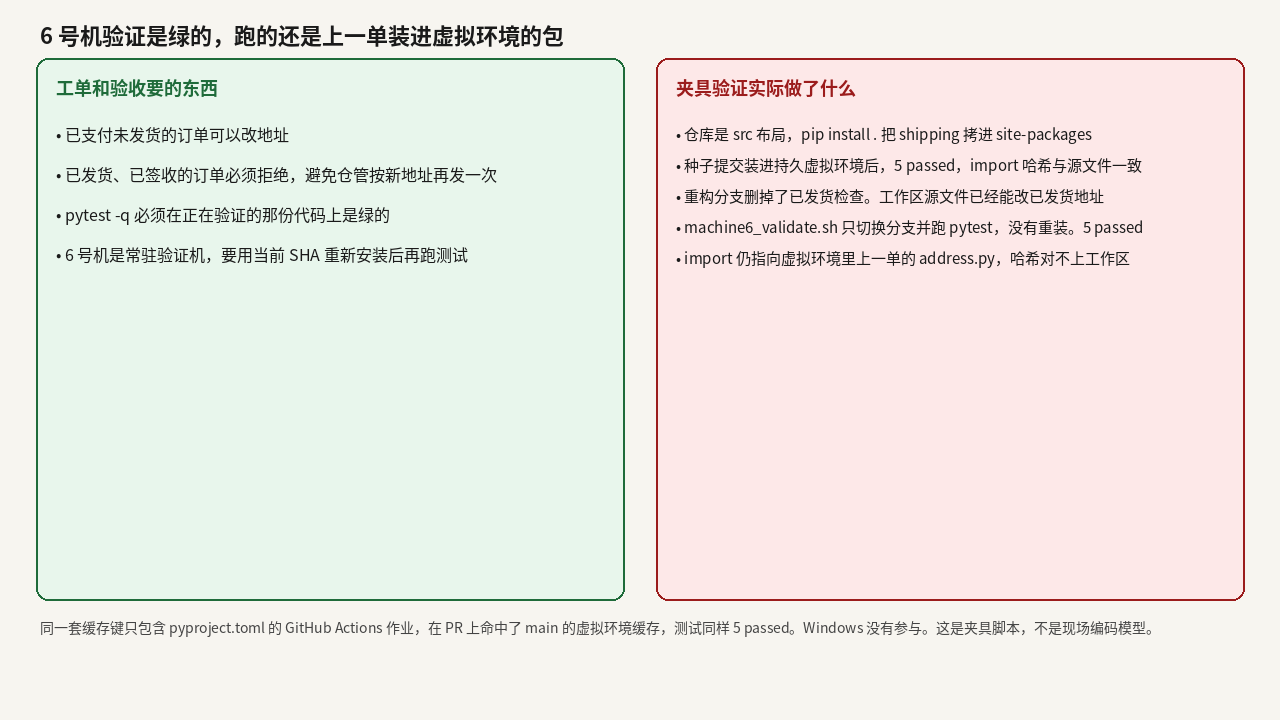
这不是测试被跳过,也不是断言写错了。那两条 test_shipped_cannot_update 和 test_delivered_cannot_update 一直在仓库里,写法也没有改。它们要失败,前提是导入到的 update_address 不再抛错。未重装时,导入到的仍是种子那一版,所以这两条测试继续通过。4、5 号机如果只问「验证绿了吗」,6 号机会给出肯定的答案。7 号机如果据此合入,main 上就会留下一个已发货仍能改地址的 helper。这和 6 号机贴了 windows-ok,验证过的那个提交已经不是 HEAD 不是同一层。那次是标签还在、提交已经变了;这次标签还没贴,测试自己就在上一份安装结果上报了绿。
同一份坏掉的工作区,我接着补了对照。pip install --force-reinstall --no-deps . 之后,闸门通过,因为 site-packages 里的文件已经变成 9188b03f…;pytest 变成 2 failed, 3 passed,失败的正是那两条已发货、已签收的用例。另建一个全新的虚拟环境再安装,结果相同。可编辑安装是另一条路:在种子上执行 pip install -e .,导入路径是 src/shipping/address.py,切换到重构分支之后,不用重装就会 2 failed。给那个未重装的旧虚拟环境加上 PYTHONPATH=src,也会变成 2 failed,因为工作区里的源文件抢在了 site-packages 前面。这两种做法都有效,前提是验证机或 CI 真的在用它们。默认的 pytest -q 并不会这么做。
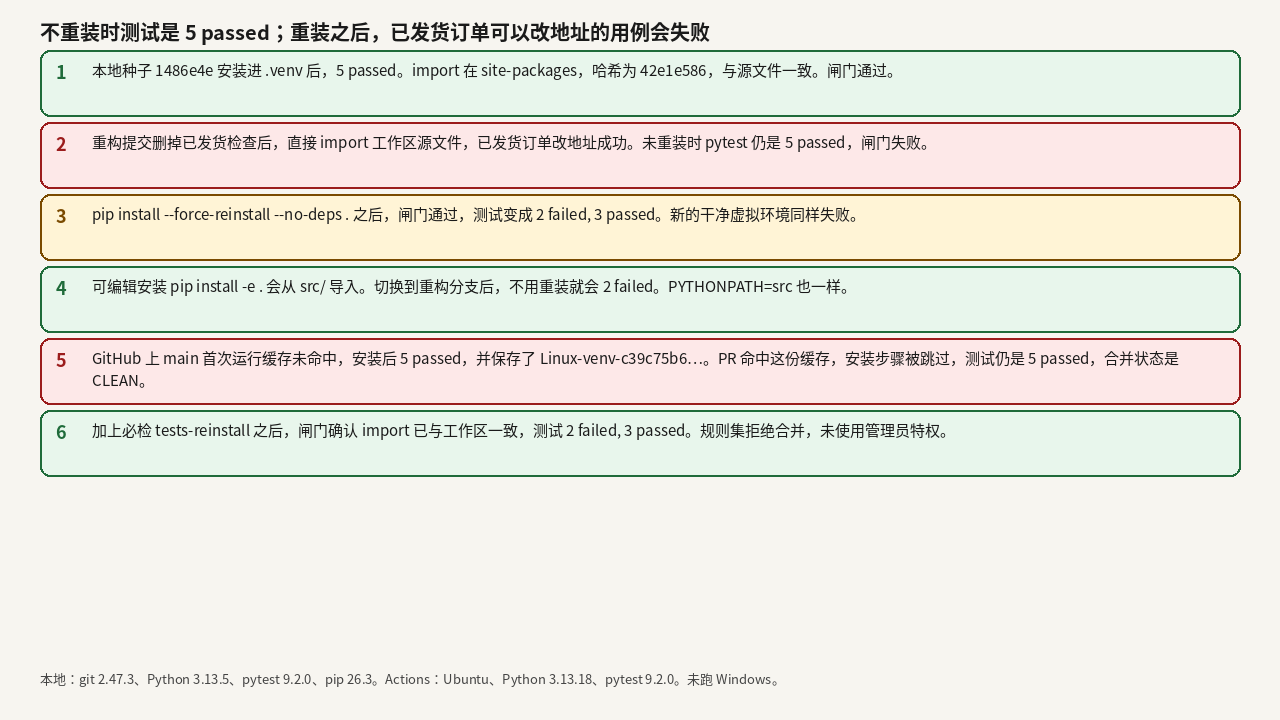
GitHub 上可以单独核对。实验室仓库的规则集编号是 28288702,名称 protect-main,bypass 列表为空,当前身份的 bypass 是 never。main 在 550a689(相对本地种子只多了 .gitignore)上第一次跑 ci 46137239776 时,缓存未命中,作业安装了项目,测试 5 passed,哈希仍是 42e1e586…,并保存了键 Linux-venv-c39c75b6…。这个键只对 pyproject.toml 做哈希,不包含应用程序源文件。时间是 2026-11-28 18:52:51(Asia/Shanghai)。我没有在这次实验室里改版本号或依赖,就是为了让缓存键保持不变。应用程序源文件改了,键仍是 Linux-venv-c39c75b6…。若把源文件哈希也写进键里,这次假绿不会出现,但那等于每次改代码都要重建整个虚拟环境,代价接近于不缓存项目安装。更省的做法是键仍然只跟依赖走,作业却必须从 HEAD 再执行一次 pip install --force-reinstall --no-deps .。pip 的下载缓存可以留,装包这一步不能省。
PR #1 的重构提交先是 02200a2。运行 46137595539 打出 Cache hit,安装步骤被标成 skipped。imported_sha256 仍是 42e1e586…,workspace_sha256 已经是 9188b03f…。测试还是 5 passed。当时还没有把重装作业设成必检,PR 的 mergeStateStatus 是 CLEAN,mergeable 是 MERGEABLE。日志自己已经写出了哈希不一致,作业却把它当成成功。时间是 2026-11-28 18:57:43(Asia/Shanghai)。
随后 main 合入了 ci-good 工作流(7a6afd8),规则集把 tests-reinstall 设为必检,创建于 2026-11-28 18:59:12(Asia/Shanghai)。PR 把 main 合并进来之后,头变成 1cba6d2。缓存命中的那条 tests 作业 46137707513 仍然成功,哈希对不上,5 passed。重装作业 46137707519 里,闸门确认 import 已与工作区一致,都是 9188b03f…,随后测试是 2 failed, 3 passed,作业失败。此时 mergeStateStatus 变成 BLOCKED。我执行了一次不带 --admin 的 gh pr merge --squash,GitHub 返回「the base branch policy prohibits the merge」。这张 PR 没有合入。
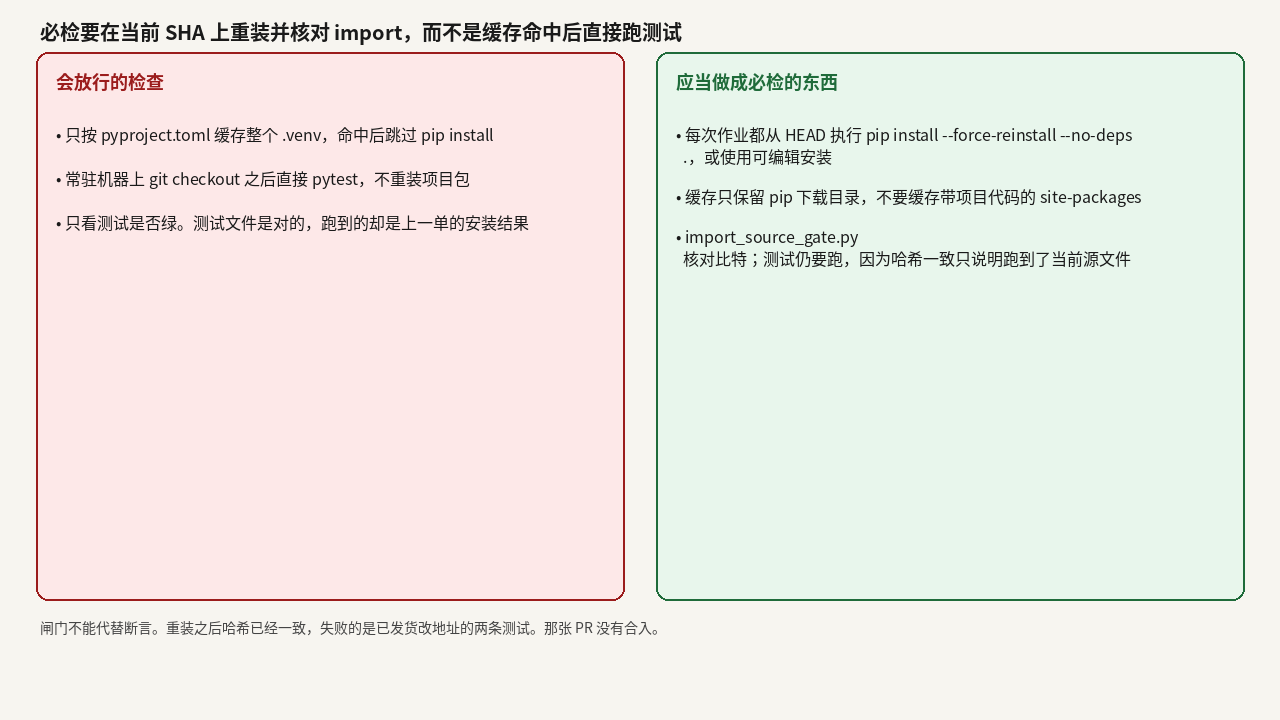
把整个 .venv 按依赖文件缓存起来、命中后跳过安装,是很常见的加速写法。GitHub 也允许 pull request 恢复默认分支上的缓存。这样写的代价是:应用程序代码变了,缓存键没变,作业跑到的仍是上一单装好的包。setup-python 的 issue #488 里,有人在自托管 runner 上看到上一份工作流装过的包出现在下一份工作流里。这次实验室用的是 GitHub 托管的 Ubuntu 跑者,靠的是官方 actions/cache,不需要自托管也能复现。6 号机那台常驻 Windows 验证机我没有在 Windows 上跑,不能替那边的路径下结论。机制是一样的:只要安装结果留在工作区之外的虚拟环境里,git checkout 清不掉它。
有人会说,那就一律用可编辑安装,或者在 pytest 里配置 pythonpath = src。这两条在实验室里都有效,我也建议日常验证优先这么做。它们解决的是「导入从哪来」的问题,并不自动成为合并条件。代理人仍然可以在 workflow 里写回「缓存命中就跳过安装」。所以合并决定还是要落在必检上:每次从 HEAD 重装,或者核对比特,再跑测试。闸门本身不能代替断言——重装之后哈希已经一致,拦住这张 PR 的是那两条会失败的测试。如果有人同时把测试改弱,闸门仍会通过;审查时仍要看测试文件有没有被改。这次的 import_source_gate.py 只核对比了 shipping.address 这一份文件。它能抓住这篇里的回归,因为被删掉的检查就在这个文件里。若过期的是另一个未纳入闸门的模块,这个窄闸门会漏掉。真正要装进仓库的版本,应当把安装结果里的项目文件和 src/ 下的对应文件整棵比对,而不是只抽一个 helper。即便如此,哈希一致也只说明跑到了当前源文件,不能说明行为是对的。所以必检仍然要包含重装之后的测试。
适用边界也要说清楚。如果项目根本不是作为包安装的,验证时一直用 PYTHONPATH=src pytest,或者每次作业都在一次性容器里从零安装,这篇里的假绿不会出现。若把实现模块直接放在仓库根下,而不是 src/ 里面,Python 也可能优先导入工作区,表现会和这篇不同,不能把这次结果套过去。紧急热修同样要重装:可以在分支上先改,但合进 main 之前,必检必须对着当前 SHA 的安装结果跑。缓存 pip 的下载目录是合理的,不需要为了正确性放弃所有缓存。
还有一个交接上的问题。6 号机如果只在 PR 里回一句「验证通过,5 passed」,4、5、7 号机看不到 import 路径,也看不到两个哈希。这次 GitHub 作业其实把哈希写进了日志,可是作业结论仍是成功,合并状态在加上必检之前是 CLEAN。也就是说,证据已经在日志里了,只要没有人去对,就不会进入合并决定。把 show_imported.py 的输出做成闸门,而不是只写成一行日志,就是为了不让这笔对账停在「有人可以去看」。常驻机器上的本地验证同样应该把这两个哈希贴进验证评论;只贴通过数,等于把最关键的那一行留在了 6 号机的终端里。6 号机如果也用同一套「缓存虚拟环境、命中就跳过安装」的脚本,本地和 CI 会一起报绿,互相印证,反而更难发现。这次实验室把两条路分开跑,就是为了说明它们是同一类错误,不是谁给谁当备胎。
可以明天就做的步骤,不必先改组织策略。项目如果是 src 布局,不要默认假设「测试导入的就是工作区」。验证脚本里先执行 pip install --force-reinstall --no-deps .,或在新的虚拟环境里 pip install -e .。CI 只缓存 ~/.cache/pip,不要缓存带项目代码的 .venv。把 import_source_gate.py 和重新安装后的测试设成规则集必检,bypass 留空。审查时如果只看到「6 号机绿了」或「tests 作业绿了」,先看日志里的 imported_file 和两个哈希是否一致。不要把「虚拟环境已经建好」写成验证清单上的完成项。环境建好,只说明上一单装过;它说明不了这一单跑的是哪一份代码。把这两个哈希写进必检,比在审查清单上写一句「记得看日志」更可靠,也更不容易被跳过。
实际跑过的内容
- 本地:git 2.47.3,Python 3.13.5,pytest 9.2.0,pip 26.3。种子
1486e4e安装后 5 passed,import 哈希42e1e586…,闸门通过。重构提交410d9e0后,工作区哈希变成9188b03f…,直接导入源文件已能改已发货地址;未重装时 pytest 仍是 5 passed,闸门失败,machine6_validate.sh同样 5 passed。 pip install --force-reinstall --no-deps .之后闸门通过,测试 2 failed, 3 passed。全新虚拟环境同样失败。pip install -e .从src/导入,切换分支后不用重装就会失败。给旧虚拟环境加上PYTHONPATH=src,也会失败。- 实验室仓库 iotxing-lab-stale-install-20261128,规则集 28288702,必检
tests-reinstall,bypass 为空,current_user_can_bypass为never。Actions 使用 Python 3.13.18、pytest 9.2.0。 - main 在
550a689上的 运行 46137239776 缓存未命中,5 passed,保存键Linux-venv-c39c75b6…,时间 2026-11-28 18:52:51(Asia/Shanghai)。PR #1 头为02200a2时,运行 46137595539 缓存命中,安装被跳过,import 哈希仍是42e1e586…,工作区是9188b03f…,5 passed,mergeStateStatus为CLEAN,时间 2026-11-28 18:57:43(Asia/Shanghai)。 - 加入
ci-good后 main 为7a6afd8。PR 合并 main 后头为1cba6d2。tests运行 46137707513 仍成功;tests-reinstall运行 46137707519 闸门通过,测试 2 failed, 3 passed。mergeStateStatus为BLOCKED。不带--admin的合并被拒绝。PR 未合入。
未跑:Windows 或 windows-latest,现场编码模型,以及自托管 runner 本身。没有使用管理员特权。夹具提交不是现场跑编码模型得到的。可复制的脚本和夹具在 stale-install-kit.tar.gz。下一步是把自己仓库里的验证作业改成对当前 SHA 重装,并把 import 闸门和重装后的测试设成必检。
Three people, seven computers. Machines 1 to 3 run coding agents, 4 and 5 review, 6 does Windows validation, and 7 merges. The ticket was specific: let paid, not-yet-shipped orders change the shipping address; reject the change when the status is shipped or delivered, or the warehouse may ship a second time to the new address. Acceptance is that pytest -q is green. Machine 6 is a standing validation machine, with a persistent checkout and virtualenv. The ticket said: before validating a SHA, reinstall the project from that tree. Do not keep using the package installed by the last job.
The repo uses a src layout. The implementation lives in src/shipping/address.py. The tests do from shipping.address import update_address, and src/ is not on sys.path by default. The first pip install . copies shipping into the virtualenv's site-packages. After that, a git checkout followed by pytest still imports the copy that was already installed, not the source sitting in the workspace.
A little more precisely: when Python starts, the first entry on sys.path is usually the directory of the script, or the current working directory, and only then site-packages. This repo has no top-level shipping/ package, only src/shipping/. So when you run pytest from the repo root, the interpreter does not find shipping in the current directory, and it falls back to the copy already installed in the virtualenv. show_imported.py lives under scripts/, so its sys_path0 is scripts/, and it cannot see the workspace implementation either. That is why the log's imported_file points at .venv/.../site-packages/shipping/address.py even when you are standing in a workspace that has already changed. A flat layout, with the implementation at the repo root, may not hit this import order. This lab did not switch to a flat layout, so that result should not be copied over.
The agent move on machine 2 is a refactor that looks reasonable: take the status check out of the helper, and leave a comment saying the caller will check the order status. This is a fixture commit I wrote in the shape of a typical agent change. I did not start a coding model to produce the diff. machine-2-agent and machine6_validate.sh are fixture identities, not real people. The local run used git 2.47.3, Python 3.13.5, pytest 9.2.0, and pip 26.3. GitHub Actions used Ubuntu, Python 3.13.18, and pytest 9.2.0. Windows was not involved. --admin was not used. The lab repo is the public iotxing-lab-stale-install-20261128, so a ruleset would actually apply.
The local seed is 1486e4e. At that point the helper rejects address changes on shipped and delivered orders. I created a persistent virtualenv in the repo, ran pip install . pytest, and ran the tests: 5 passed. scripts/show_imported.py printed imported_file at .venv/lib/python3.13/site-packages/shipping/address.py, hash 42e1e586…, matching the workspace source. import_source_gate.py exited 0.
Then the fixture script scripts/drop_shipped_guard.py ran on a branch, at 410d9e0. The workspace address.py hash became 9188b03f…. Importing that file with PYTHONPATH=src let a shipped order change its address to "Customer New Address". The tree that would be merged already violates the ticket. The fixture script on machine 6 only switched branches and ran pytest -q. It did not reinstall. The tests were still 5 passed. imported_file was still in site-packages, still hashed 42e1e586…, and no longer matched the workspace. The gate exited 1. machine6_validate.sh was also 5 passed.
A standing validation machine is where this habit forms most easily. Machine 6 is supposed to run Windows validation. Setting the environment up once takes time. The last job just installed it, and those tests were green, so the next job is tempted to pull the code and run again. A coding agent is even more likely to treat “the virtualenv is already there” as a shortcut. AGENTS.md did tell it to reinstall. The fixture script does not read that file, and machine6_validate.sh has no install step. A rule is advice, not enforcement.
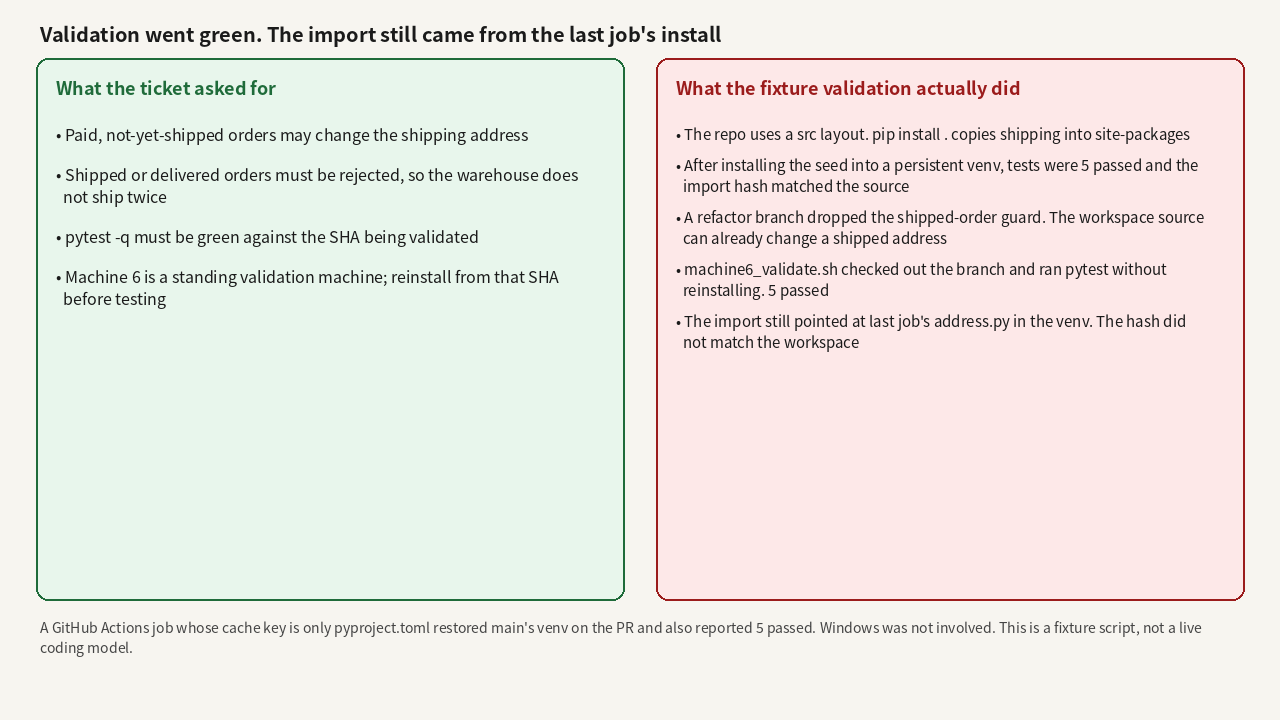
This is not a skipped test, and the assertions were not wrong. test_shipped_cannot_update and test_delivered_cannot_update were in the repo the whole time, and their bodies did not change. They fail only when the imported update_address no longer raises. Without a reinstall, the import was still the seed, so those two tests kept passing. If machines 4 and 5 only ask whether validation was green, machine 6 says yes. If machine 7 merges on that basis, main gets a helper that still changes the address of a shipped order. This is not the same layer as machine 6 pasted windows-ok, and the commit it validated is no longer HEAD. That post was about a label that outlived the commit. This time no label was involved: the tests themselves reported green against the previous install.
I then ran contrasts on the same broken workspace. After pip install --force-reinstall --no-deps ., the gate passed, because the file in site-packages was now 9188b03f…. pytest became 2 failed, 3 passed, and the failures were exactly the shipped and delivered cases. A brand-new virtualenv, then a fresh install, failed the same way. An editable install is a different path: pip install -e . on the seed imports from src/shipping/address.py, and checking out the refactor branch fails two tests with no reinstall. Adding PYTHONPATH=src to the stale non-editable venv also yields 2 failed, because the workspace source now precedes site-packages. Both approaches work, if the validation machine or CI actually uses them. A plain pytest -q does not.
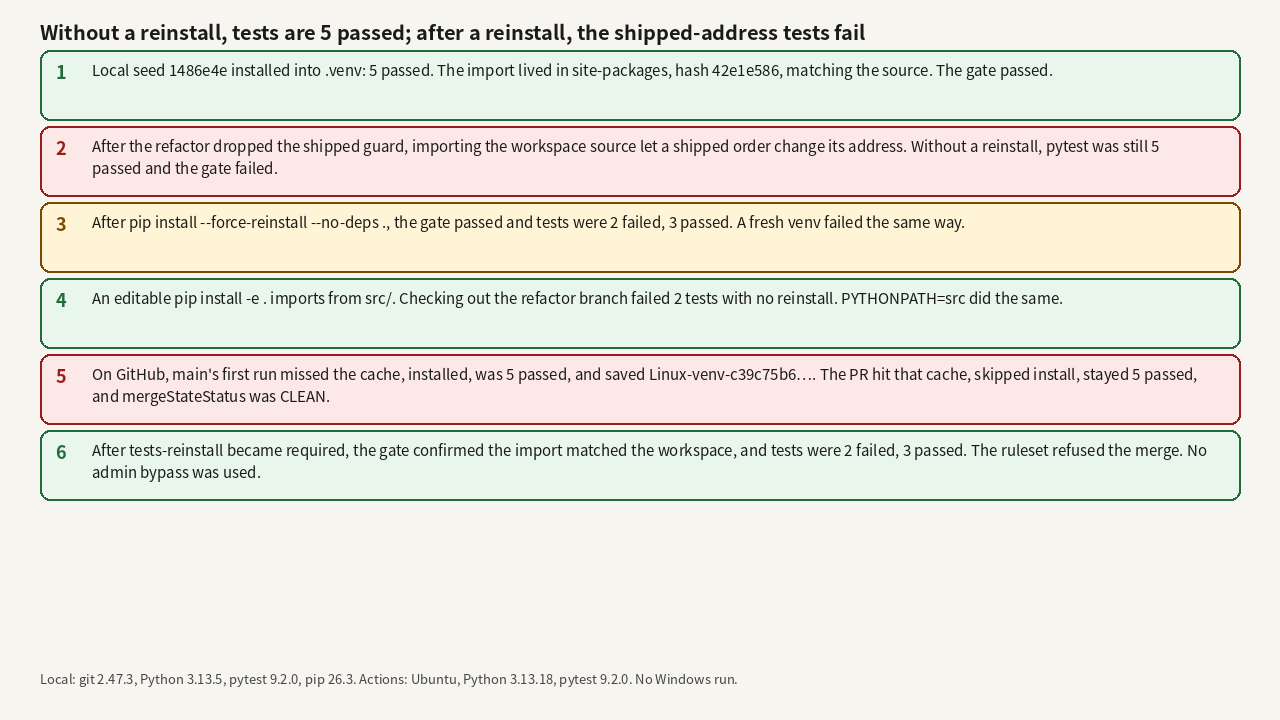
The GitHub side can be checked on its own. The lab repo's ruleset is 28288702, named protect-main, with an empty bypass list, and current_user_can_bypass is never. On main at 550a689 (the local seed plus a .gitignore), the first ci run 46137239776 missed the cache, installed the project, was 5 passed, still hashed 42e1e586…, and saved the key Linux-venv-c39c75b6…. That key hashes only pyproject.toml, not the application source. The time was 2026-11-28 18:52:51 (Asia/Shanghai). I did not change the version or the dependencies in this lab, so the cache key would stay the same. The application source changed; the key was still Linux-venv-c39c75b6…. Putting the source hash into the key would have avoided this false green, but it would rebuild the whole virtualenv on every code change, which is close to not caching the project install at all. The cheaper fix is to keep the key tied to dependencies, and still run pip install --force-reinstall --no-deps . from HEAD in every job. The pip download cache can stay. The project install step cannot be skipped.
PR #1 first pointed at the refactor commit 02200a2. Run 46137595539 printed a cache hit, and the install step was marked skipped. imported_sha256 was still 42e1e586…. workspace_sha256 was already 9188b03f…. The tests were still 5 passed. The reinstall job was not yet a required check, so the PR's mergeStateStatus was CLEAN and mergeable was MERGEABLE. The log itself had already printed the hash mismatch, and the job still counted as success. The time was 2026-11-28 18:57:43 (Asia/Shanghai).
Main then gained the ci-good workflow (7a6afd8), and the ruleset made tests-reinstall required, at 2026-11-28 18:59:12 (Asia/Shanghai). After the PR merged main, the head was 1cba6d2. The cache-hit tests job, run 46137707513, still succeeded, with mismatched hashes and 5 passed. In the reinstall job, run 46137707519, the gate confirmed the import matched the workspace, both 9188b03f…, and then the tests were 2 failed, 3 passed, so the job failed. mergeStateStatus became BLOCKED. A gh pr merge --squash without --admin came back with "the base branch policy prohibits the merge". The pull request was not merged.
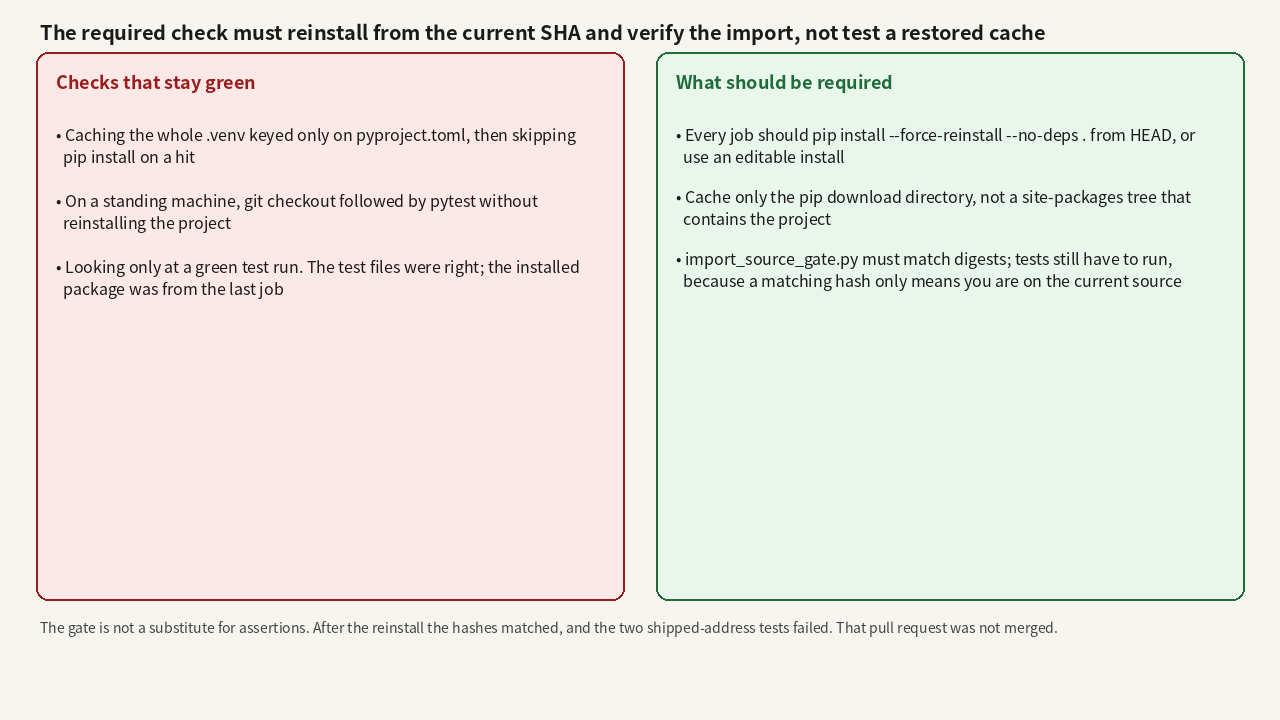
Caching the whole .venv from a lockfile or project metadata, then skipping the install on a hit, is a common way to save minutes. GitHub also lets a pull request restore a cache from the default branch. The cost of that pattern is: the application source changed, the cache key did not, and the job still ran against the package installed by the last job. In setup-python issue #488, a package installed by one workflow on a self-hosted runner showed up in another. This lab used GitHub-hosted Ubuntu runners and the official actions/cache action. A self-hosted runner was not required to reproduce it. I did not run the standing Windows validation machine, and I cannot speak for paths on that OS. The mechanism is the same: if the install lives in a virtualenv outside the checkout, git checkout will not remove it.
A reasonable response is to always use an editable install, or to set pythonpath = src in pytest. Both worked in the lab, and I would start daily validation that way. They fix where the import comes from. They do not automatically become a merge condition. An agent can still write a workflow that skips the install on a cache hit. The merge decision still has to land on a required check: reinstall from HEAD every time, or verify the digest, then run the tests. The gate is not a substitute for assertions. After the reinstall the hashes already matched; what blocked this PR was the two tests that failed. If someone also weakens the tests, the gate will still pass. Review still has to look at whether the test files changed. The import_source_gate.py in this lab only compared shipping.address. That was enough here, because the deleted check lives in that file. If a different module were stale and not included in the gate, this narrow check would miss it. The version you actually install in a repo should compare the installed project files with the matching tree under src/, not a single helper. Even then, a matching hash only means you are running the current source. It does not mean the behavior is right. The required check still has to include the tests after the reinstall.
The limits should be stated clearly. If the project is not installed as a package, if validation always runs PYTHONPATH=src pytest, or if every job starts from a scratch container, the false green in this post does not appear. If the implementation module sits at the repo root instead of under src/, Python may import the workspace first, and the result will differ; do not copy this outcome onto that layout. An emergency hotfix is not an exception: the work can start on a branch, but the required check still has to run against an install from the current SHA before it enters main. Caching pip's download directory is reasonable. You do not have to give up all caching to get this right.
There is also a handoff problem. If machine 6 only replies on the PR with “validation passed, 5 passed”, machines 4, 5, and 7 never see the import path or the two hashes. This GitHub job did write the hashes into the log, but the job still concluded success, and the merge state was CLEAN before the required check was added. The evidence was already in the log; if nobody compared the two hashes, they never entered the merge decision. Turning the output of show_imported.py into a gate, rather than a line in the log, is how that comparison stops being optional. Local validation on a standing machine should paste the same two hashes into the validation comment. Posting only the pass count leaves the important line on machine 6's terminal. If machine 6 also uses the same “cache the virtualenv, skip install on a hit” script, local validation and CI will go green together and confirm each other, which makes the miss harder to see. The lab ran the two paths separately so it would be clear they are the same class of error, not backups for each other.
There is a step that can be done tomorrow, without waiting for an organization policy change. If the project uses a src layout, do not assume that tests import the workspace. In the validation script, run pip install --force-reinstall --no-deps . first, or pip install -e . in a fresh virtualenv. In CI, cache only ~/.cache/pip, not a .venv that contains the project. Make import_source_gate.py and the tests after a reinstall required checks on a ruleset, with an empty bypass list. If review only sees that machine 6 was green, or that the tests job was green, look at imported_file in the log and whether the two hashes match. Do not treat “the virtualenv is already set up” as a completed item on the validation checklist. A ready environment only means the last job installed something. It does not tell you which tree this job ran. Putting the two hashes into a required check is more reliable than adding “remember to read the log” to a review checklist.
What was actually run
- Locally: git 2.47.3, Python 3.13.5, pytest 9.2.0, pip 26.3. After installing seed
1486e4e, tests were 5 passed, the import hash was42e1e586…, and the gate passed. After refactor commit410d9e0, the workspace hash became9188b03f…, and importing the source file directly could change a shipped address. Without a reinstall, pytest was still 5 passed, the gate failed, andmachine6_validate.shwas also 5 passed. - After
pip install --force-reinstall --no-deps ., the gate passed and tests were 2 failed, 3 passed. A fresh virtualenv failed the same way.pip install -e .imports fromsrc/and failed after checkout with no reinstall. AddingPYTHONPATH=srcto the stale venv also failed. - Lab repo iotxing-lab-stale-install-20261128, ruleset 28288702, required check
tests-reinstall, empty bypass list,current_user_can_bypassisnever. Actions used Python 3.13.18 and pytest 9.2.0. - On main at
550a689, run 46137239776 missed the cache, was 5 passed, and savedLinux-venv-c39c75b6…, at 2026-11-28 18:52:51 (Asia/Shanghai). PR #1 at02200a2, run 46137595539 hit the cache, skipped the install, kept import hash42e1e586…against workspace9188b03f…, was 5 passed, andmergeStateStatuswasCLEAN, at 2026-11-28 18:57:43 (Asia/Shanghai). - After
ci-goodlanded, main was7a6afd8. After the PR merged main, the head was1cba6d2.testsrun 46137707513 still succeeded.tests-reinstallrun 46137707519 passed the gate and was 2 failed, 3 passed.mergeStateStatuswasBLOCKED. A merge without--adminwas refused. The pull request was not merged.
Not run: Windows or windows-latest, a live coding model, and a self-hosted runner itself. Admin privileges were not used. The fixture commits were not produced by a live coding model. The copyable scripts and fixtures are in stale-install-kit.tar.gz. The next step is to make your own validation job reinstall from the current SHA, and to make the import gate and the tests after that reinstall required checks.