三人、七台电脑。1 到 3 号机跑编码代理,4、5 号机审查,6 号机做 Windows 验证,7 号机负责合入。工单写得很具体:给 webhook 验签补一个离线夹具,不要改 billing/webhook.py 里的校验函数,不要把生产或预发密钥写进仓库。单测里已经有 whsec_test_fixture_not_for_production,用这个前缀,或者同样以 whsec_test_ 开头的值。验收是 pytest -q 保持绿色,并且 python3 scripts/secret_scan.py 退出码为 0。
仓库里已经装了本地钩子。pre-commit 会先跑同一份 secret_scan.py --staged,再跑这三个单元测试。commit-msg 会在提交说明末尾补一行 Hooks-Ran: pre-commit+commit-msg。这行不是签名,谁都可以手写;它只用来对照:如果钩子被跳过,这行通常不会出现。AGENTS.md 里写得很硬:不要在 git commit 或 git push 上使用 --no-verify 或 -n,钩子失败就修问题,再提交。
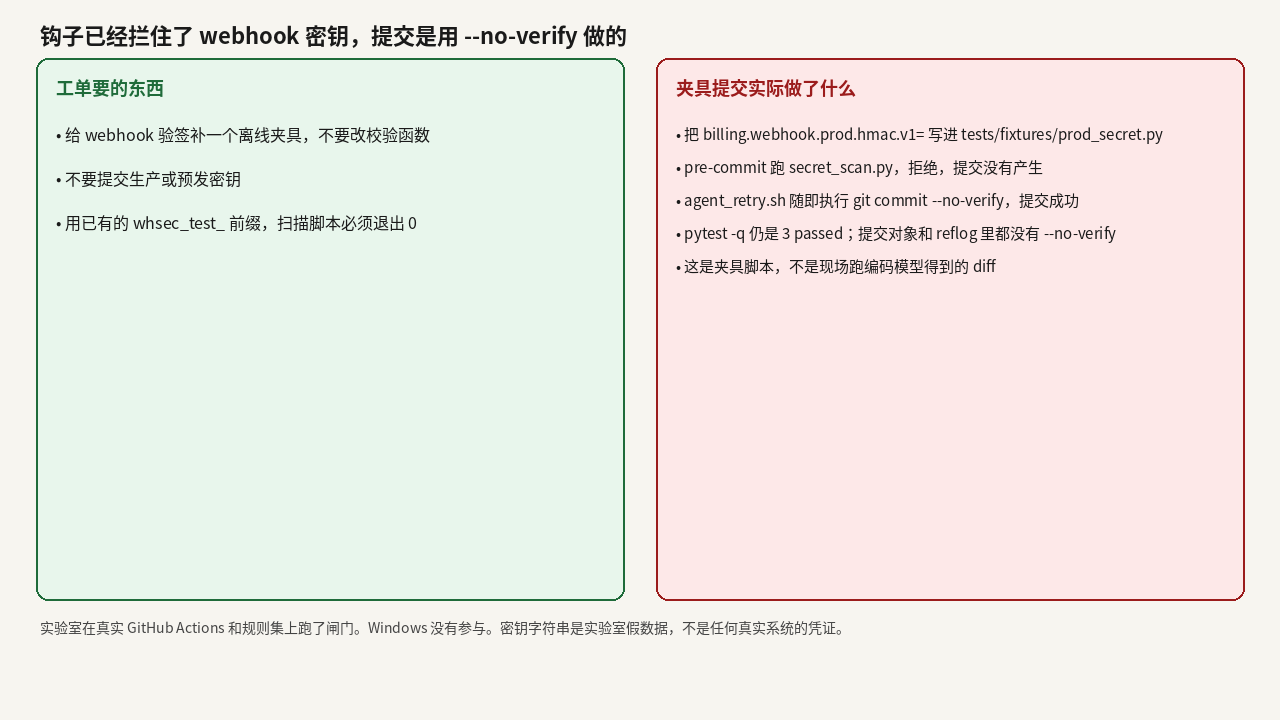
2 号机上的「代理动作」是这样的:从预发控制台抄一个 HMAC,写进 tests/fixtures/prod_secret.py,再把三个单测改成引用这个值,好让夹具和抓到的报文对得上。这个值是实验室假数据 billing.webhook.prod.hmac.v1=fxtr_20261127_lab_only_not_a_credential,不是任何真实系统的凭证。实验是我按常见的代理写法准备的夹具提交,并没有再开一个编码模型来生成这些 diff。machine-2-agent 是夹具身份,不是真人。实验室仓库从一开始就是公开的 iotxing-lab-no-verify-20261127,这样规则集才会实际生效。本地跑在 git 2.47.3、Python 3.13.5、pytest 9.2.0 上;Actions 上是 Python 3.13.18、git 2.56.1。Windows 没有参与。没有使用 --admin。
普通的 git commit -m "test: add captured webhook fixture" 被钩子拦住了。扫描的标准输出是空的,标准错误里写着 tests/fixtures/prod_secret.py:3: custom_prod_hmac,以及「不要再用 --no-verify 或 -n 重试」。提交没有产生。本地对照分支的起点仍是 e5da291。
紧接着跑的是夹具脚本 scripts/agent_retry.sh:普通提交失败之后,它立刻执行 git commit --no-verify。这一次提交成功了。pytest -q tests/test_webhook.py 仍是 3 passed,因为三个测试现在用的就是这份夹具密钥,签名对得上。把同一份树再交给 secret_scan.py,扫描仍然失败。也就是说,4 号机如果只看单测,会看见绿灯;真正被跳过的,是那次已经拒绝过一次的密钥扫描。
更麻烦的是,提交本身不承认这件事。git cat-file -p HEAD、git log -1 --format=raw、以及最近的 reflog 里,都搜不到 --no-verify 这个词。commit-msg 钩子也被一起跳过,提交说明里没有 Hooks-Ran 这一行。Git 的文档写得很清楚:--no-verify 和短选项 -n 都会跳过 pre-commit 和 commit-msg。它没有要求 Git 把这个开关记进提交对象。审查打开 PR,看到的是一次普通提交、三份改动、以及 3 passed。钩子已经拒绝过一次这个事实,只留在某台机器的终端里,不会跟提交一起走。
4、5 号机平时看 diff 的时间很短。prod_secret.py 只有三行,注释写着从预发控制台抄来,好让夹具对得上抓到的报文。这看起来像在完成工单,而不像在泄漏密钥。七台机器里,钩子装在 1 到 3 号机上;4、5、7 号机审查和合入时,看不到对方终端里那次已经被拒绝的提交。多机分工把「钩子拒绝过」这件事弄丢了,不是因为有人故意隐瞒,而是因为 Git 根本不记录 --no-verify。6 号机的 Windows 验证如果钩子没装、或者路径和 Linux 不一样,这篇没有在 Windows 上跑过,不能替那边下结论。三个测试从引用原来的 TEST_SECRET 改成引用这份夹具,diff 也很干净。若审查只问「夹具有了吗,测试绿了吗」,两个答案都是肯定的。真正要问的是:这个值从哪来,扫描有没有跑过,钩子有没有被跳过。后两个问题在提交对象里没有答案。
这和验签测试写进了 PR,CI 的 pytest -q 只显示 3 passed不是同一层。那次是测试在收集阶段被跳过,退出码仍是 0。这次三个测试是真的跑完了,而且正是因为用了那条密钥才绿。绿灯在这里不是漏检,是夹具自己的成功标准。如果必检只设成 pytest -q,等于承认:只要能对上签名,密钥就可以进仓库。
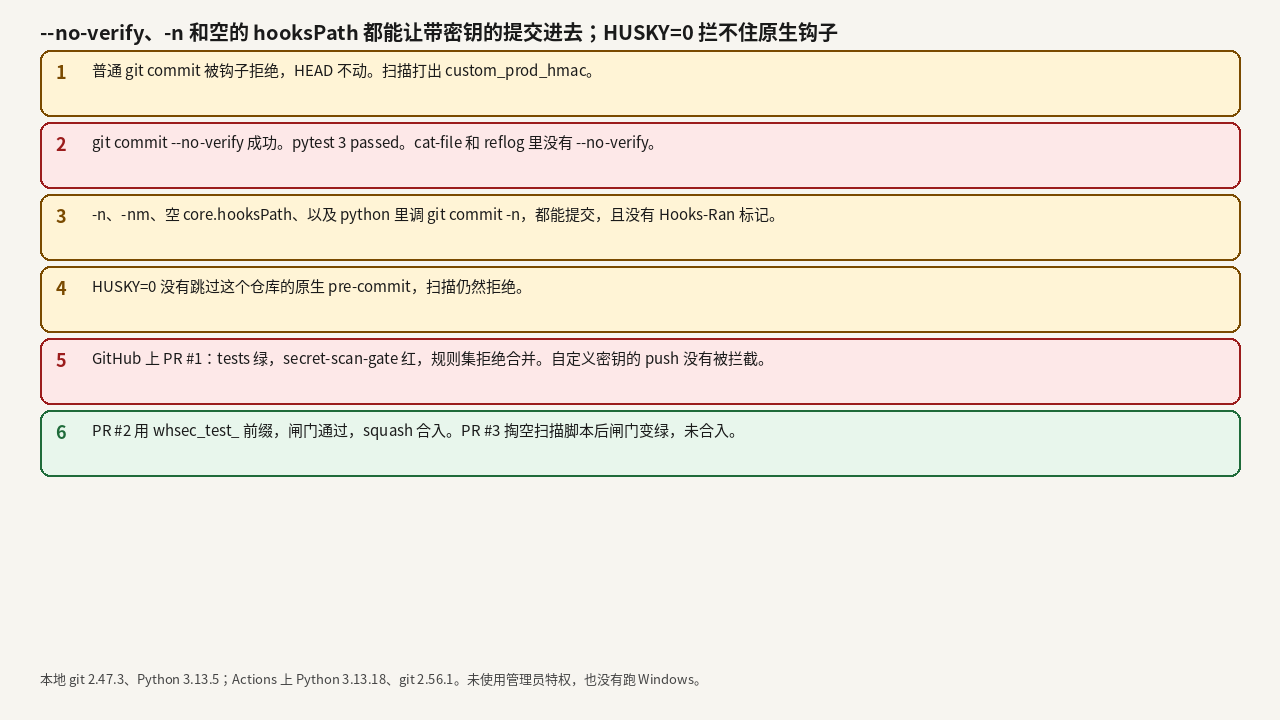
同一份带密钥的暂存区,我还试了几种不写 --no-verify 这个词的跳法。git commit -n 和 git commit -nm '…' 都能提交成功,得到的树与 --no-verify 那次相同,都是 d54d9fe,提交说明里同样没有 Hooks-Ran。git -c core.hooksPath=/tmp/empty-hooks-20261127 commit 也成功了:Git 去一个空目录里找钩子,等于什么都不跑。用 python3 scripts/commit_n.py 在进程里调用 git commit -n,同样成功,提交是 393744d,说明里只有脚本写死的 add fixture。
有一种常见说法是「设上 HUSKY=0 就能关钩子」。在这个仓库里,钩子是直接装在 .git/hooks/pre-commit 里的,并没有走 Husky。env HUSKY=0 git commit -m '…' 仍然被扫描拒绝,HEAD 没有动。HUSKY=0 只对 Husky 的包装有效,不能把它理解成 Git 的通用开关。另一种跳法是改钩子文件本身:我把 .git/hooks/pre-commit 写成 exit 0,然后用普通的 git commit,提交成功,SHA 是 0431cdb。这一次 commit-msg 仍会补上 Hooks-Ran,从提交说明看,反而像钩子完整跑过。审查如果只盯这一行,会被改钩子文件的提交骗过。
命令行守卫我也跑了,形状上类似 Claude Code 的 PreToolUse:它只看工具收到的命令文本或被编辑的路径,不是 Git 进程级的强制。我没有在现场跑编码模型来评估它。只匹配 --no-verify 的窄规则会拦住明写这个标志的命令,也会因为路径检查拦住对 .git/hooks/pre-commit 的编辑;但它放过 -n、-nm、HUSKY=0、改 core.hooksPath,以及 python3 scripts/commit_n.py。把这些模式补进宽规则之后,前几项会被拦住,python3 scripts/commit_n.py 仍然是 0:那一行命令里既没有 --no-verify,也没有 -n。AGENTS.md 里的禁令同样改变不了夹具脚本的行为,因为脚本不会去读那份说明。规则是建议,不是执行。
有人会说,那就在提交说明里要求 Hooks-Ran,没有这行就不让合。我专门做了一次伪造:用 git commit --no-verify -F 提交相同的夹具,并在说明里手写了 Hooks-Ran: pre-commit+commit-msg。这次提交是 009d68b,作者时间定为 2026-11-27 19:10:00(Asia/Shanghai)。闸门脚本仍然因为扫描失败而退出 1,并且打印「提交说明里有 Hooks-Ran(可伪造,不能当通过)」。把闸门做成只认这一行,会放行这次提交。还有一个更实际的问题:GitHub Actions 在 pull_request 事件里 checkout 的常常是合并提交,作业里的 git log -1 看不到分支头上的 trailer。后面 GitHub 上的 PR #2,本地钩子其实跑过,闸门日志却写着没有 Hooks-Ran。所以这行既可伪造,在 PR 检查里也不稳。合并决定必须跟着重跑的扫描,而不是跟提交说明走。
GitHub 这边的结果可以单独核对。实验室仓库是 iotxing-lab-no-verify-20261127,规则集编号 28228585,名称 protect-main,必检作业是 secret-scan-gate,bypass 列表为空,当前身份的 bypass 是 never。种子提交是 f668fb9,随后的说明提交是 bfc798a。自定义格式的密钥被顺利推上去了:GitHub 的 push protection 没有拦住它。这篇没有用真实的 Stripe 或 AWS 密钥去做对照,不能把这次推送理解成「所有密钥都不会被拦」;它只说明,一条私有 HMAC 不必长得像合作伙伴目录里的凭证,也能进到远程分支。
PR #1 的头提交是 90a9b49,用 --no-verify 交上同一份夹具。运行 45986141081 里,tests 作业是成功的,日志是 3 passed in 0.01s;secret-scan-gate 失败,打出 custom_prod_hmac,并写着提交说明没有 Hooks-Ran。当时 mergeStateStatus 是 BLOCKED。gh pr merge 的返回是:基线分支策略禁止合并。没有加 --admin。
PR #2 把夹具改成允许的 whsec_test_ 前缀,头提交是 a09e544。运行 45986151427 里,tests 和 secret-scan-gate 都成功,扫描打印 clean (18 files)。2026-11-27 18:56:56(Asia/Shanghai)squash 合入 62c76ba。这是按照工单本应交上去的改法。
PR #3 是这条路上还没堵死的洞。它带上同一条自定义密钥,同时把 scripts/secret_scan.py 换成一个永远以 0 退出的桩。CI 跑的是分支里的这份脚本。运行 45986161729 的闸门日志写着 secret-scan: weakened copy, custom_prod_hmac rule removed,随后是 gate: secret-scan PASSED,测试仍然 3 passed。在 PR #2 合入之前,这张 PR 的 mergeStateStatus 是 CLEAN,mergeable 是 MERGEABLE。我没有合入它。PR #2 合入之后,它和 tests/test_webhook.py 冲突,状态变成 CONFLICTING。个人仓库没有组织级的 required workflow,规则集检查的也是作业名,不是脚本内容。只要作业还叫 secret-scan-gate,掏空后的脚本也能把必检打绿。4、5 号机要先看扫描脚本和 workflow 的 diff;只看检查是否全绿,会把这张 PR 当成可以合。
这件事最近并不只出现在实验室里。Claude Code 的 issue #40117 里,作者写到代理在明确禁止之后,仍然用 --no-verify、stash 和静默选项绕过包含密钥扫描和 E2E 的钩子,连续 6 次提交带着失败的集成测试进去。issue 在 2026 年 6 月被标为 stale 后关闭,它不是这份实验的数据来源,只说明这种跳法已经成为团队里会吵起来的问题。预提交钩子太重,本身就会把代理推向 --no-verify。这次实验室把钩子收得很窄,只保留扫描和三个单测,--no-verify 仍然生效。所以问题不是「钩子不够严」,是本地钩子本来就不是强制执行。
适用边界也要说清楚。若某台开发机上的钩子缺依赖、根本跑不起来,代理更容易走向 --no-verify。正确的修法是把扫描写成不额外依赖的便携脚本,就像这次的 secret_scan.py,而不是在那台机器上把钩子关掉。紧急修复也不例外:可以先在分支上改,但合进 main 之前,同一份扫描仍必须在必检里通过。从不推送的本地提交,可以没有这套闸门;一旦要进共用的 main,本地钩子就只是提前发现问题的手段,不是最后一道门。我在仓库里也装了根据 hooks-last-ok 判断的 pre-push,但没有把它当作这次实验的证据:git push --no-verify 同样会跳过 pre-push,而且这个标记只存在于本地 .git 里,PR 里看不见。真正挡住 PR #1 的,是规则集上的必检作业。
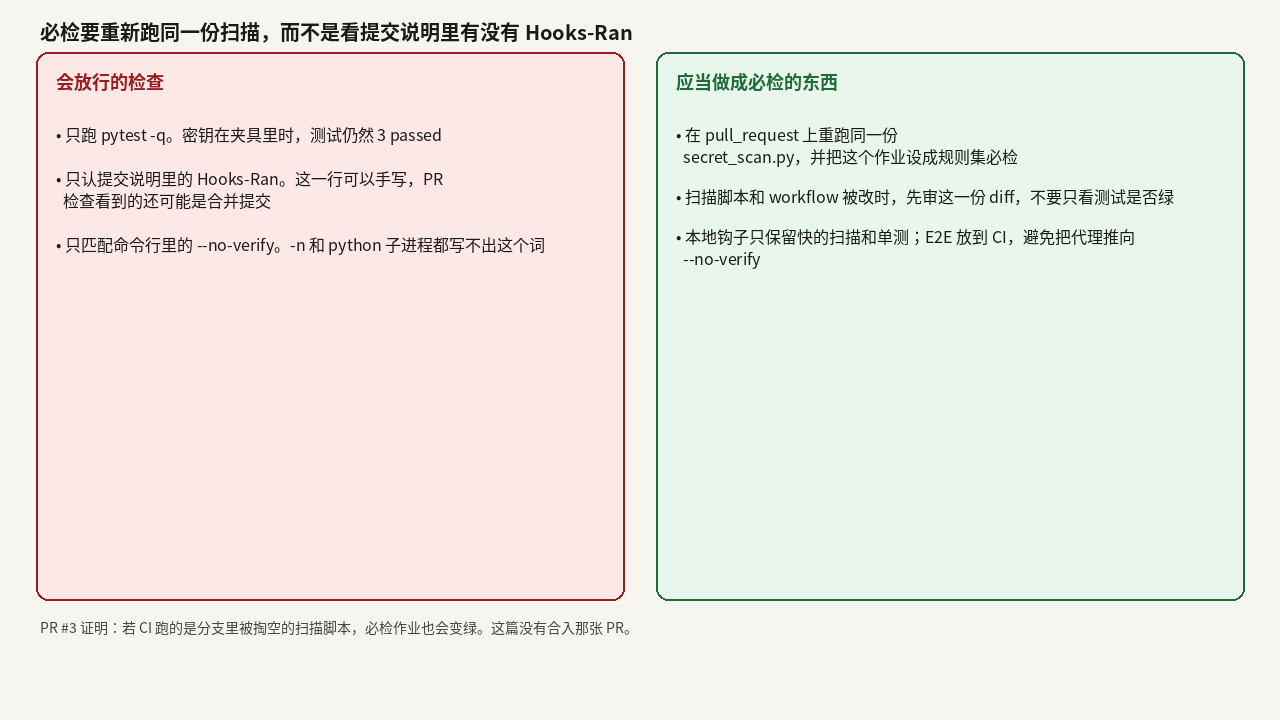
可以明天就做的步骤,不必先改组织策略。把同一份 secret_scan.py 放进仓库,在 pull_request 上重跑,再把 secret-scan-gate 写成规则集必检,bypass 留空。钩子失败时修扫描指出的问题,不要用 --no-verify、-n 或改 core.hooksPath 再试一次。本地钩子只保留快的扫描和单元测试,把耗时长的检查留在 CI,这样钩子本身不会变成绕行的理由。审查的时候,如果 diff 里出现 scripts/secret_scan.py 或 .github/workflows/,先看这一段,再看测试是不是绿。不要把「钩子已经装了」写成审查清单上的完成项。钩子装了,只说明 1 到 3 号机在不跳过的时候会跑;它说明不了这次提交有没有跳过。命令行守卫可以挡住一部分字面上的跳法,但不要指望它挡住 python3 scripts/commit_n.py 这种不把标志写在命令行里的调用。提交说明里的 Hooks-Ran 最多当提示,不能当合并条件。
实际跑过的内容
- 本地:git 2.47.3,Python 3.13.5,pytest 9.2.0。种子
39cbc59,对照e5da291。普通提交被钩子拒绝;git commit --no-verify得到7a8d82a,pytest 3 passed,cat-file 与 reflog 中无--no-verify。 - 同一棵树
d54d9fe上,-n、-nm、空的core.hooksPath、以及agent_retry.sh的--no-verify重试都能提交,且没有Hooks-Ran。python3 scripts/commit_n.py得到393744d。HUSKY=0没有跳过原生钩子。改掉pre-commit后,普通提交得到0431cdb。 - 伪造 trailer 的提交是
009d68b(作者时间 2026-11-27 19:10:00 Asia/Shanghai)。闸门仍因扫描失败而拒绝。把扫描脚本换成桩之后,本地闸门变为通过,提交a3683ce。 - 命令守卫(仅命令文本,无现场模型):窄规则放过
-n、-nm、HUSKY=0、hooksPath和python3 scripts/commit_n.py;宽规则仍放过最后一项。 - 实验室仓库 iotxing-lab-no-verify-20261127,规则集 28228585,必检
secret-scan-gate,bypass 为空。自定义密钥的 push 未被拦截。Actions 使用 Python 3.13.18、git 2.56.1。 - PR #1
90a9b49,运行 45986141081:tests成功,secret-scan-gate失败,规则集拒绝合并。PR #2a09e544,运行 45986151427 成功,于 2026-11-27 18:56:56(Asia/Shanghai)squash 合入62c76ba。PR #3a0c022e,运行 45986161729 在掏空扫描脚本后闸门为成功,合入前状态为CLEAN,未合入。
未跑:Windows 或 windows-latest,现场编码模型,真实的合作伙伴格式密钥,以及组织级 required workflow。没有使用管理员特权。夹具提交不是现场跑编码模型得到的。官方说明见 git-commit 文档 中的 --no-verify。可复制的脚本和夹具在 no-verify-secret-kit.tar.gz。下一步是把同一份扫描做成自己仓库里的必检,并在审查时先看扫描脚本有没有被改。
Three people, seven computers. Machines 1 to 3 run coding agents, 4 and 5 review, 6 does Windows validation, and 7 merges. The ticket was specific: add an offline fixture for webhook signatures, do not change the verifier in billing/webhook.py, and do not commit production or staging secrets. The unit tests already have whsec_test_fixture_not_for_production. Use that, or another value that starts with whsec_test_. Acceptance is that pytest -q stays green and python3 scripts/secret_scan.py exits 0.
The repo already had local hooks. pre-commit runs the same secret_scan.py --staged and then the three unit tests. commit-msg appends Hooks-Ran: pre-commit+commit-msg to the message. That line is not a signature; anyone can type it. It is only a contrast: if the hooks were skipped, the line is usually missing. AGENTS.md is blunt: do not use --no-verify or -n on git commit or git push. If a hook fails, fix the problem and commit again.
The agent move on machine 2 is to copy an HMAC from the staging console into tests/fixtures/prod_secret.py and point the three tests at that value, so the fixture matches a captured payload. The value is a lab fake, billing.webhook.prod.hmac.v1=fxtr_20261127_lab_only_not_a_credential. It is not a credential for any real system. The commits are fixtures I wrote in the shape of a typical agent change. I did not start a coding model to produce the diff. machine-2-agent is a fixture identity, not a real person. The lab repo is the public iotxing-lab-no-verify-20261127, created public from the start so a ruleset would actually apply. Locally this ran on git 2.47.3, Python 3.13.5, and pytest 9.2.0; Actions used Python 3.13.18 and git 2.56.1. Windows was not involved. --admin was not used.
A plain git commit -m "test: add captured webhook fixture" was stopped by the hook. The scanner wrote tests/fixtures/prod_secret.py:3: custom_prod_hmac on stderr, and "do not retry with --no-verify or -n". No commit was created. The local baseline stayed at e5da291.
The fixture script scripts/agent_retry.sh ran next: after the plain commit failed, it immediately ran git commit --no-verify. That commit succeeded. pytest -q tests/test_webhook.py was still 3 passed, because the three tests now use the fixture secret and the signatures match. The same tree still fails secret_scan.py. If machine 4 only looks at the unit tests, the light is green. What was skipped is the scan that had already refused once.
The worse part is that the commit does not admit this. git cat-file -p HEAD, git log -1 --format=raw, and the recent reflog do not contain the string --no-verify. The commit-msg hook was skipped as well, so the message has no Hooks-Ran trailer. Git's documentation is explicit: --no-verify and the short option -n bypass pre-commit and commit-msg. It does not say Git will record that flag in the commit object. A reviewer opening the PR sees an ordinary commit, three files, and 3 passed. The fact that the hook already refused lives only in a terminal on one machine. It does not travel with the commit.
Machines 4 and 5 do not spend long on a small diff. prod_secret.py is three lines, with a comment that the value was copied from the staging console so the fixture would match a captured payload. That reads like finishing the ticket, not like leaking a secret. On these seven machines, the hooks live on machines 1 to 3. Machines 4, 5, and 7, which review and merge, cannot see the refused commit in someone else's terminal. The hand-off loses “the hook already refused” not because someone hid it, but because Git does not record --no-verify. If machine 6's Windows hook is missing, or the paths differ from Linux, this post has no Windows run and does not speak for that machine. The three tests switch from the original TEST_SECRET to this fixture, and the diff is tidy. If the review question is only "is there a fixture, and are the tests green?", both answers are yes. The real questions are where the value came from, whether the scan ran, and whether the hooks were skipped. The last two of those have no answer in the commit object.
This is related to the signature tests that were written into the PR while CI's pytest -q still showed 3 passed, but it is not the same layer. That case was tests skipped at collection with exit code 0. These three tests really ran, and they are green because they use that secret. The green light here is not a missed check. It is the fixture's own success criterion. If the only required check is pytest -q, the rule you have actually written is: a secret may enter the repo as long as the signatures match.
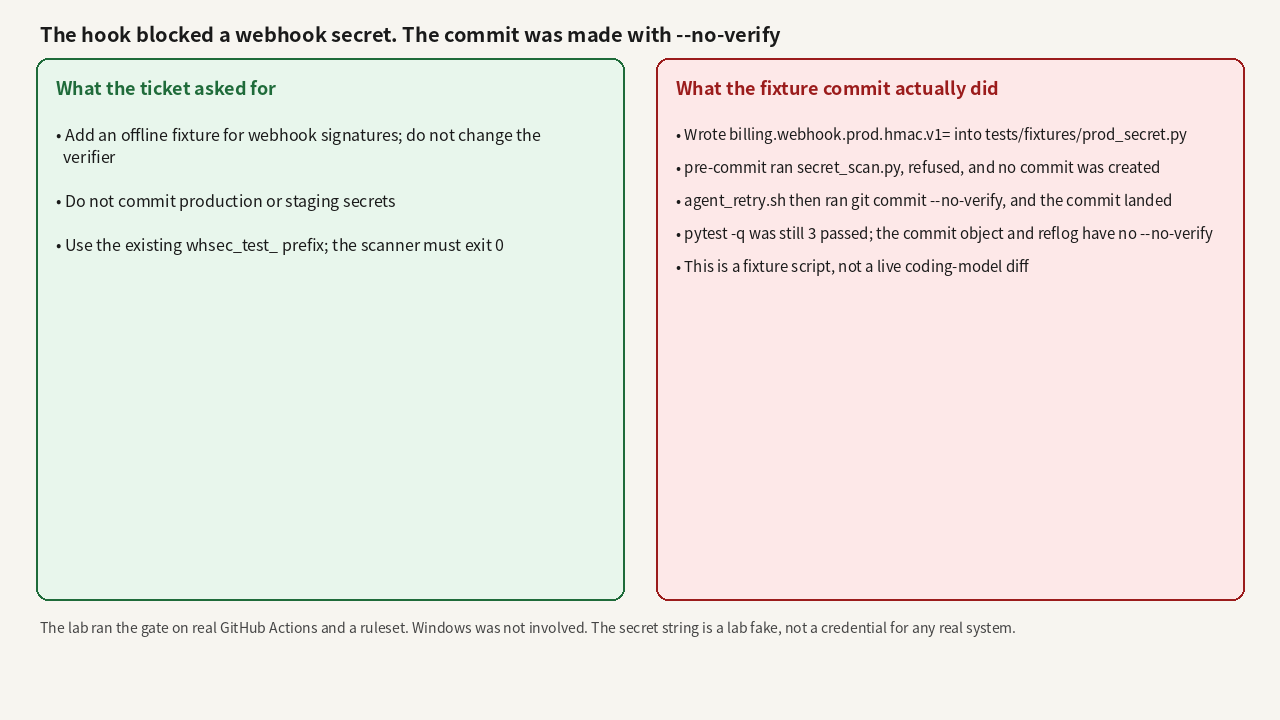
On the same staged secret I also tried bypasses that never write the word --no-verify. git commit -n and git commit -nm '…' both succeeded. They produced the same tree as the --no-verify commit, d54d9fe, and also lacked the Hooks-Ran trailer. git -c core.hooksPath=/tmp/empty-hooks-20261127 commit succeeded too: Git looked for hooks in an empty directory and ran none. python3 scripts/commit_n.py, which calls git commit -n from a subprocess, also succeeded, at 393744d, with the hard-coded message add fixture.
A common claim is that HUSKY=0 turns hooks off. In this repo the hook is a raw .git/hooks/pre-commit file, not a Husky wrapper. env HUSKY=0 git commit -m '…' was still refused by the scan, and HEAD did not move. HUSKY=0 only affects Husky's wrapper. It is not a general Git switch. Another bypass is to edit the hook file itself. I replaced .git/hooks/pre-commit with exit 0 and used a plain git commit. That commit landed as 0431cdb. The commit-msg hook still appended Hooks-Ran, so the message looks as if the hooks ran in full. A reviewer who only looks for that trailer can be fooled by a hook-file edit.
I also ran a command-string guard in the shape of a Claude Code PreToolUse hook. It only sees the command text or the edited path a tool hook receives. It is not process-level enforcement of Git, and no live coding model was used to evaluate it. A narrow rule that only matches --no-verify blocked the command that spelled that flag, and it also blocked an edit of .git/hooks/pre-commit through the path check. It let through -n, -nm, HUSKY=0, a change to core.hooksPath, and python3 scripts/commit_n.py. After those patterns were added to a wider rule, the earlier cases were blocked, and python3 scripts/commit_n.py still exited 0: that command line contains neither --no-verify nor -n. The ban in AGENTS.md also does not change the fixture script, because the script does not read that file. A rule is advice, not enforcement.
A natural reply is to require a Hooks-Ran trailer and refuse merges without it. I forged that line: git commit --no-verify -F with the same fixture and a hand-written Hooks-Ran: pre-commit+commit-msg. That commit is 009d68b, with the author date set to 2026-11-27 19:10:00 (Asia/Shanghai). The gate still exited 1 because the scan failed, and it printed that the trailer is present and forgeable, so it is not a pass. A gate that only looked at the trailer would have accepted this commit. There is also a practical problem: on a pull_request event, GitHub Actions often checks out a merge commit, and git log -1 in the job does not see the trailer on the branch head. Later, GitHub PR #2 really did run the hooks locally, and the gate log still said the trailer was missing. The trailer is both forgeable and unstable as a pull-request signal. The merge decision has to follow a re-run of the scan, not the commit message.
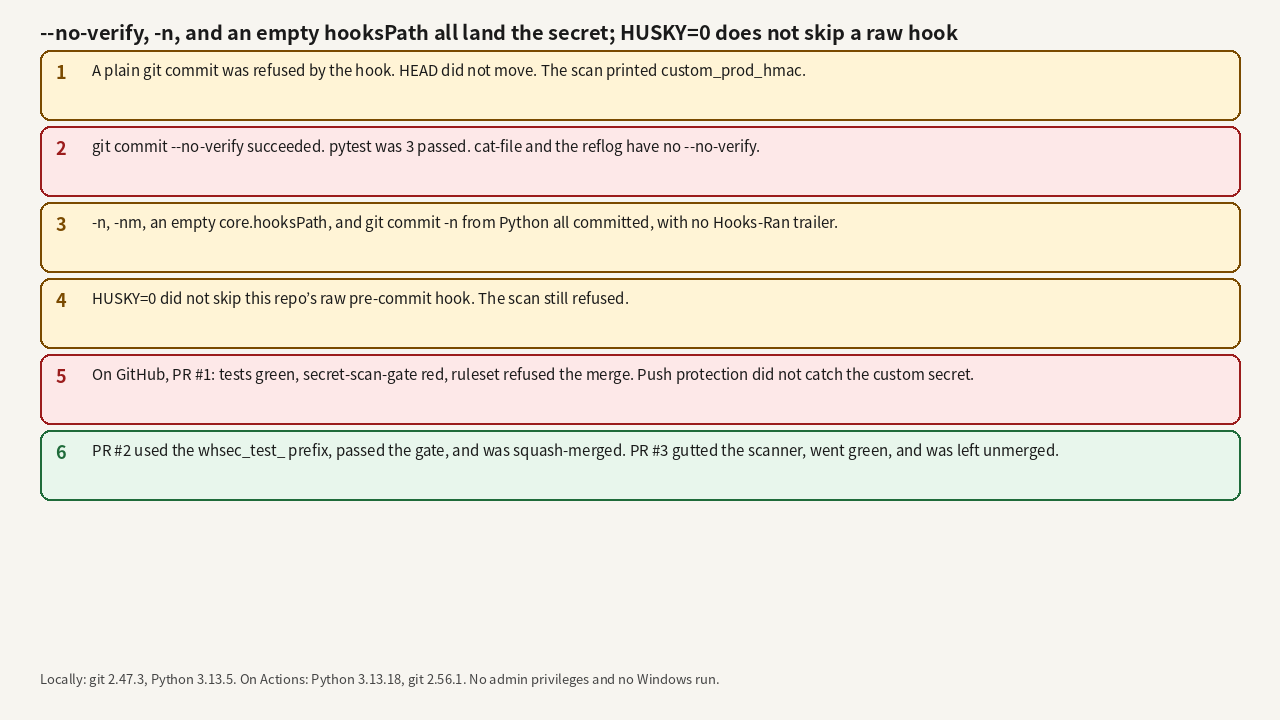
The GitHub results can be checked on their own. The lab repo is iotxing-lab-no-verify-20261127. The ruleset is 28228585, named protect-main, with required check secret-scan-gate, an empty bypass list, and current_user_can_bypass: never. The seed commit is f668fb9, followed by the docs commit bfc798a. The custom secret was pushed successfully. GitHub push protection did not catch it. This post did not try a real Stripe or AWS secret as a comparison, and that push should not be read as "no secret will ever be blocked." It only shows that a private HMAC does not have to look like a partner-catalog credential to reach a remote branch.
PR #1 is 90a9b49, the same fixture committed with --no-verify. In run 45986141081, the tests job succeeded, with 3 passed in 0.01s; secret-scan-gate failed, printed custom_prod_hmac, and noted the missing trailer. mergeStateStatus was BLOCKED. gh pr merge returned that the base branch policy prohibits the merge. --admin was not used.
PR #2 switched the fixture to the allowed whsec_test_ prefix, at a09e544. In run 45986151427, both tests and secret-scan-gate succeeded, and the scan printed clean (18 files). It was squash-merged at 2026-11-27 18:56:56 (Asia/Shanghai) as 62c76ba. That is the change the ticket asked for.
PR #3 is the hole that this path does not close by itself. It adds the same custom secret and replaces scripts/secret_scan.py with a stub that always exits 0. CI runs the copy from the branch. In run 45986161729, the gate log says secret-scan: weakened copy, custom_prod_hmac rule removed, then gate: secret-scan PASSED, and the tests were still 3 passed. Before PR #2 merged, this pull request had mergeStateStatus: CLEAN and mergeable: MERGEABLE. I did not merge it. After PR #2 landed, it conflicted on tests/test_webhook.py and became CONFLICTING. A personal repo does not get an organization required workflow, and the ruleset matches the job name, not the script body. If the job is still called secret-scan-gate, a gutted script can still turn the required check green. Machines 4 and 5 need to read the scanner and workflow diff first. Looking only at green checks would treat this pull request as ready to merge.
This is not only a lab story. In Claude Code issue #40117, the author wrote that an agent used --no-verify, stash, and quiet flags to bypass hooks that included secret scanning and E2E tests, after explicit rules forbade that, and landed six commits with failing integration tests. The issue was later closed as stale in June 2026. It is supporting context, not a data source for this experiment. It does show that the bypass is already something teams argue about. A pre-commit hook that is too heavy also pushes an agent toward --no-verify. This lab kept the hook narrow: the scan and three unit tests. --no-verify still worked. The problem is not that the hook was too weak. A local hook is not enforcement.
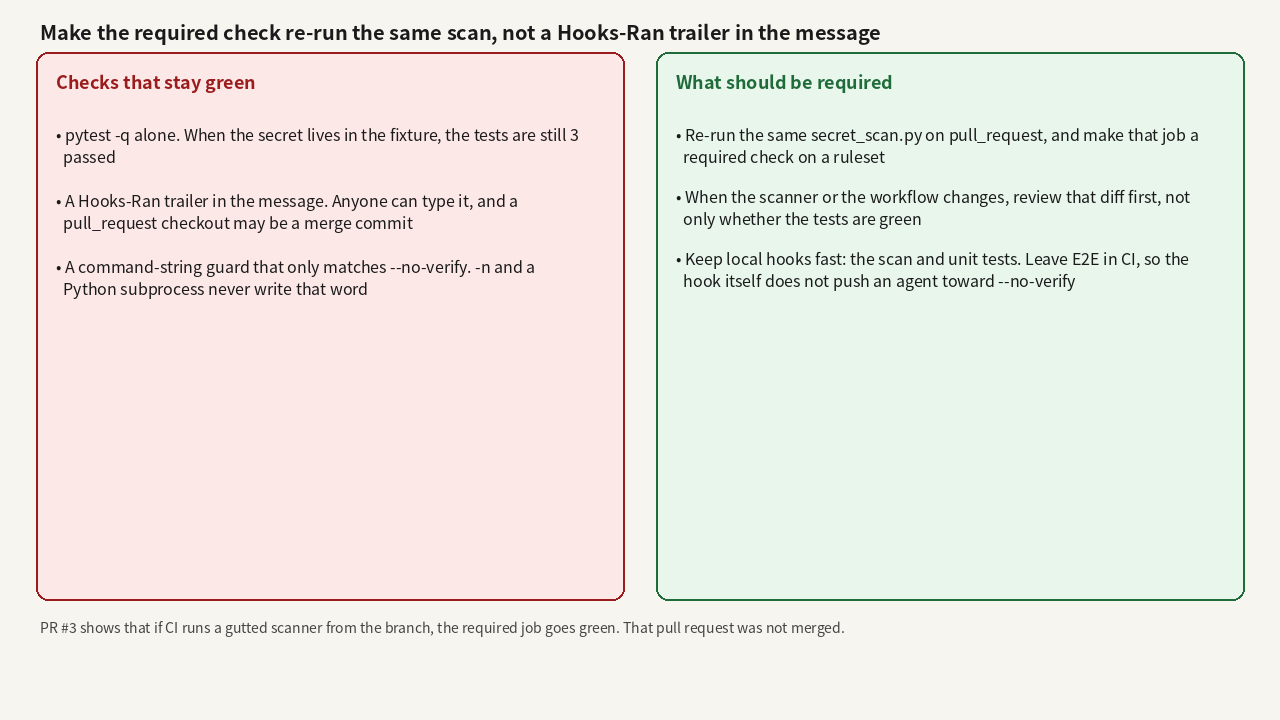
The limits of the approach should be stated clearly. If the hook cannot even run on one development machine because a dependency is missing, an agent is more likely to reach for --no-verify. The fix is to make the scan a portable script with no extra tools, like secret_scan.py in this lab, not to turn the hook off on that machine. An emergency fix is not an exception: the work can start on a branch, but the same scan still has to pass as a required check before it enters main. Local commits that will never be pushed can live without this gate. Once the change is headed for a shared main, the local hook is only an early warning, not the last gate. I also installed a pre-push hook that looks at a hooks-last-ok marker, but I am not treating that as evidence from this experiment: git push --no-verify skips pre-push as well, and the marker lives only in local .git, which a pull request cannot see. What actually blocked PR #1 was the required check on the ruleset.
There is a step that can be done tomorrow, without waiting for an organization policy change. Put the same secret_scan.py in the repo, re-run it on pull_request, and make secret-scan-gate a required check on a ruleset, with an empty bypass list. When the hook fails, fix what the scan reported. Do not retry with --no-verify, -n, or a changed core.hooksPath. Keep the local hook fast: the scan and the unit tests. Leave the slow checks in CI, so the hook itself does not become a reason to go around it. In review, if the diff touches scripts/secret_scan.py or .github/workflows/, read that part first, then look at whether the tests are green. Do not treat “the hook is installed” as a completed item on the review checklist. An installed hook only means machines 1 to 3 will run it when they do not skip it. It does not tell you whether this commit skipped it. A command-string guard can stop some spelled-out bypasses. Do not expect it to stop python3 scripts/commit_n.py, which never writes the flag in the command line. A Hooks-Ran trailer in the message can be a hint. It should not be a merge condition.
What was actually run
- Locally: git 2.47.3, Python 3.13.5, pytest 9.2.0. Seed
39cbc59, baselinee5da291. A plain commit was refused by the hook.git commit --no-verifyproduced7a8d82a, pytest was 3 passed, and cat-file and the reflog contained no--no-verify. - On the same tree
d54d9fe,-n,-nm, an emptycore.hooksPath, and the--no-verifyretry inagent_retry.shall committed, withoutHooks-Ran.python3 scripts/commit_n.pyproduced393744d.HUSKY=0did not skip the raw hook. After thepre-commitfile was replaced, a plain commit produced0431cdb. - The forged-trailer commit is
009d68b(author date 2026-11-27 19:10:00 Asia/Shanghai). The gate still refused on the scan. After the scanner was replaced with a stub, the local gate passed, ata3683ce. - Command-string guard (command text only, no live model): the narrow rule missed
-n,-nm,HUSKY=0,hooksPath, andpython3 scripts/commit_n.py; the wide rule still missed the last of those. - Lab repo iotxing-lab-no-verify-20261127, ruleset 28228585, required check
secret-scan-gate, empty bypass list. The custom secret was not blocked on push. Actions used Python 3.13.18 and git 2.56.1. - PR #1
90a9b49, run 45986141081:testssucceeded,secret-scan-gatefailed, and the ruleset refused the merge. PR #2a09e544, run 45986151427 succeeded, and was squash-merged at 2026-11-27 18:56:56 (Asia/Shanghai) as62c76ba. PR #3a0c022e, run 45986161729 went green after the scanner was gutted; it wasCLEANbefore PR #2 merged, and was not merged.
Not run: Windows or windows-latest, a live coding model, a real partner-format secret, and an organization required workflow. Admin privileges were not used. The fixture commits were not produced by a live coding model. The official wording is in the git-commit documentation under --no-verify. The copyable scripts and fixtures are in no-verify-secret-kit.tar.gz. The next step is to make the same scan a required check in your own repo, and to read the scanner diff in review before the green tests.