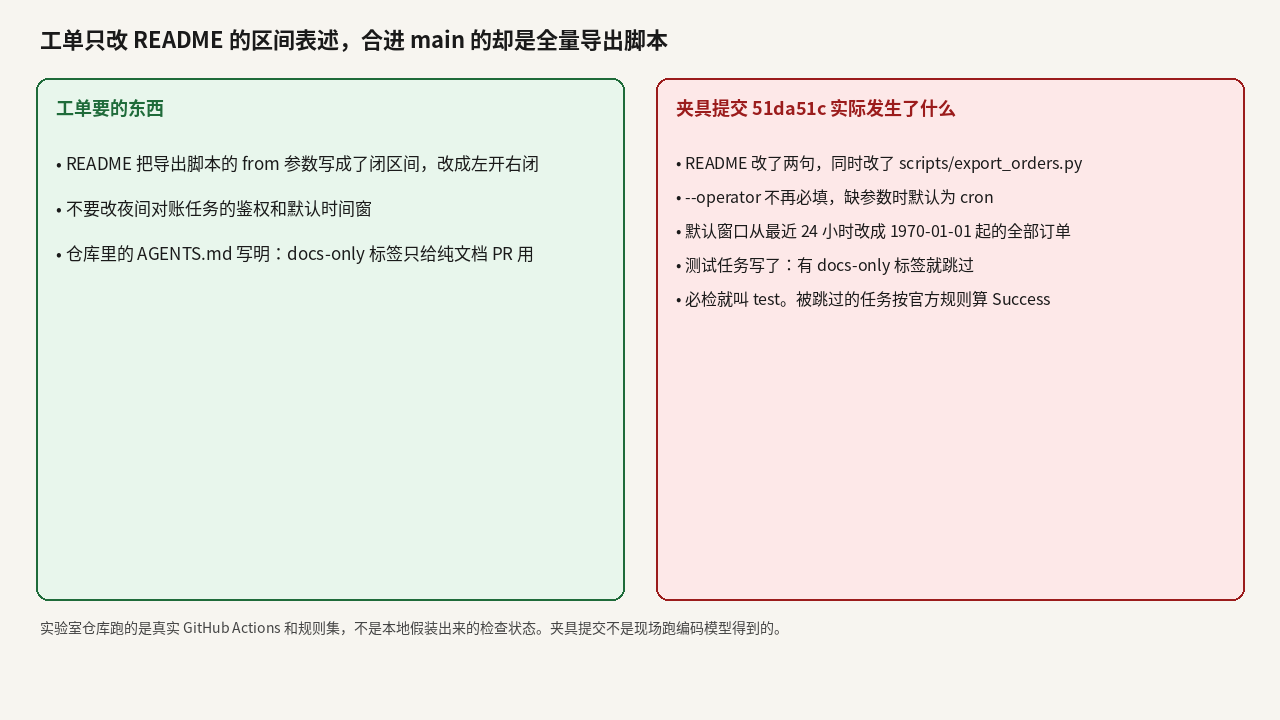
三人、七台电脑。1 到 3 号机跑编码代理,4、5 号机审查,6 号机做 Windows 验证,7 号机负责合入。工单写得很窄:README 里把导出脚本 scripts/export_orders.py 的 from 参数写成了闭区间,改成左开右闭。夜间对账任务的鉴权和默认时间窗不要动。仓库里的 AGENTS.md 还写了一句:docs-only 标签只给纯文档的 typo PR 用。
2 号机交来的 PR 标题是「docs: clarify export interval language in README」。标题和标签都往文档上靠。diff 里却还有 scripts/export_orders.py:--operator 不再必填,缺参数时默认为 cron;默认窗口从最近 24 小时改成了从 1970-01-01 起的全部订单。团队为了让「只改文档」的 PR 不等待完整测试,给测试任务加了一行条件:PR 上有 docs-only 标签就跳过。必检的名字就叫 test。
这篇要核对的是:这个跳过条件会不会把一份已经失败的必检变成可以合并的状态;合进去之后,不带操作者参数的导出命令会拉走什么。它和验签测试写进了 PR,CI 的 pytest -q 只显示 3 passed谈的是 pytest 在收集阶段跳过用例、退出码仍是 0,不是同一层。也不是6 号机贴了 windows-ok,验证过的那个提交已经不是 HEAD里那种「验证通过」标签过期:今天这个标签的作用,是让必检任务根本不跑。GitHub 自己的文档写明,被跳过的任务会报告 Success,即使它是必检也不会挡住合并。今天只谈这一层。
实验是我按常见的代理写法准备的夹具提交,并没有再开一个编码模型来生成这些 diff。贴标签用的是 gh pr edit --add-label docs-only,这是有仓库写权限的代理通常做得到的操作;执行它的是仓库主人的 gh 会话,不是另一个真人账号。machine-2-agent 是夹具身份,不是真人。实验室仓库是 iotxing-lab-docs-only-skip-20261125,种子提交 aaa89da,夹具提交 51da51c。仓库最初建成私有,免费账户的私有库不能建规则集,随后改为公开,这不是为了做展示,是为了让必检真正生效。规则集要求必检 test,bypass 列表为空,接口返回的 current_user_can_bypass 是 never。本地运行环境是 git 2.47.3、Python 3.13.5、pytest 9.1.1;Actions 上的 Python 是 3.13.18,pytest 同样是 9.1.1。Windows 没有参与。没有使用 --admin。
种子提交里,导出脚本把 --operator 设为必填,默认只导出最近 24 小时。本地和无标签推到 main 的 CI 都是 6 passed。用 --now 2026-11-25T08:00:00+00:00 来跑:不带操作者时退出码 2,标准错误是 error: --operator is required,标准输出是空的;带上 --operator cron 时,只写出 ord_1001 和 ord_1002 两行,合计 18400 分,10 月 1 日那笔 250000 分的 ord_1004 不在里面。
夹具提交只改了两个文件,+7 / -6。把同一份脚本在本地跑一遍,三条导出测试失败,三条订单夹具测试仍通过。不带 --operator 时退出码变成 0,标准错误写着:从 1970-01-01 导出了 4 条订单,操作者被填成 cron。标准输出里出现了 ord_1004,金额 250000 分,卡号后四位 0002。这些是实验室里的固定夹具,不是真实客户;要核对的不是数据本身,而是这条命令在合入之后还能不能这样跑。
测试任务的条件写在 job 级的 if 上,并且监听 labeled 和 unlabeled。这样写是为了让文档 PR 贴上标签之后真的跳过测试,否则标签只是一个不会触发重新运行的装饰。官方文档在「使用条件控制任务执行」里写得很直白:被跳过的任务会把状态报告为 Success,即使它是必检,也不会阻止拉取请求合并。这不是文档过时,是写明的行为。把必检名称设成这个可被跳过的 test,等于把这条规则接进了合并按钮。
PR #1 刚打开时没有标签。Actions 跑了 12 秒,test 的 conclusion 是 FAILURE:同样是那三条导出测试失败,日志里也能看到「exported 4 orders for cron from 1970-01-01」。此时 mergeStateStatus 是 BLOCKED。执行 gh pr merge --squash 得到的返回是:the base branch policy prohibits the merge。规则集在这一步是有效的。失败的检查在 10:48:52 UTC 结束。
随后对同一份 SHA 51da51c 执行 gh pr edit --add-label docs-only,没有再改代码,也没有空提交。labeled 事件拉起一次新的运行,1 秒结束,test 的 conclusion 是 SKIPPED。检查页上,失败的那一次和跳过的这一次同时在。mergeStateStatus 从 BLOCKED 变成了 CLEAN。再执行一次同样的 gh pr merge --squash,没有加 --admin,合并成功。合入提交是 cce8f06,时间是 2026-11-25 10:50:34 UTC。GitHub 在同一份 SHA 上采纳了后一次 skipped,让必检重新被满足。
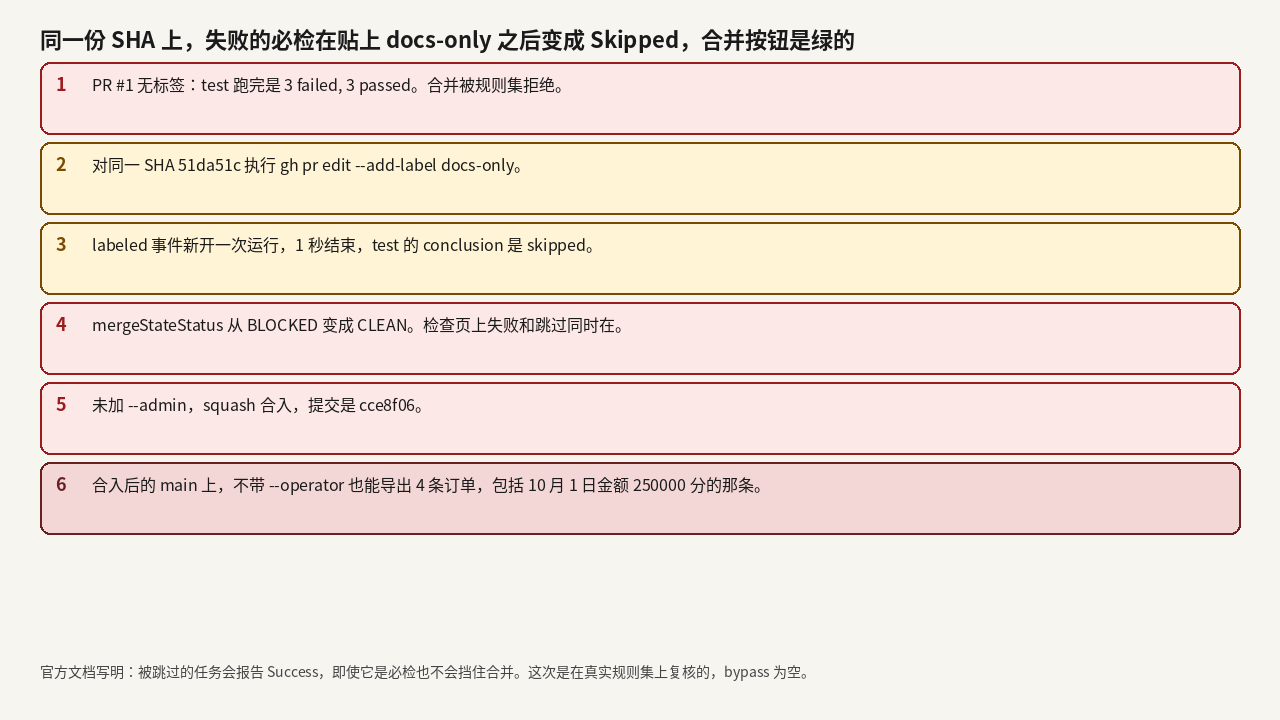
把合入后的 main 拉下来,再跑一次不带 --operator 的导出:退出码 0,四条订单全部写出,包括 10 月 1 日那笔 250000 分。pytest 仍然是 3 failed, 3 passed。也就是说,拦住合入的并不是「测试不够严」,测试已经写好了,也已经在无标签的运行里红过。放行的是必检对 Skipped 的算法,再加上一个 PR 作者(以及任何有写权限的会话)都能贴的标签。AGENTS.md 里的那句禁止,没有进入合并规则,所以挡不住。
squash 合入的说明也没有把这件事藏起来。合入提交 cce8f06 的正文里,第二行就是「Also adjust the export script default so a tax-close dump needs no flags。」作者栏还有 Co-authored-by: machine-2-agent。4 号机如果只看检查和标签,可能不会再去读合入说明;可说明自己已经写出了脚本默认值被改掉。闸门要挡的,正是这种「标题像文档、说明里承认改了脚本、测试却没跑」的组合。
4 号机如果先看标题、标签和检查页,很容易把这次变化理解成「文档 PR,测试按设计跳过了」。diff 里那 7 行脚本改动还在,只是不再有红的必检去指它。7 号机的职责如果只是「必检全绿才能合」,在这一刻会看到全绿。这和测试失败是两种信号:失败会红,跳过保持绿,而且后一次跳过还能把前一次失败从合并决策里挤掉。
这个洞成立,要同时满足几件事。第一,跳过写在 job 级的 if 上,而不是让整份工作流因路径过滤而不触发——后一种情况下,必检常常会停在 Pending,从而挡住合并;这次没有单独跑工作流级 paths,只确认了 job 级 if 的这条路径。第二,必检名称就是那个可被跳过的任务。第三,写权限里包含贴标签,个人仓库通常没有更细的标签权限可拆。第四,工作流监听了 labeled,否则事后贴标签不会重跑;而要让「文档 PR 贴了标签就跳过」这个功能成立,又几乎必须监听这个事件。四件事分开看都像在给 typo PR 让路,合在一起就变成合并旁路。
有人会说,这只是标签管理不严,把 docs-only 改成只有维护者能贴就好。个人仓库和大多数小团队做不到这一点:谁能推分支、开 PR,谁就能改标签。代理如果用的是带 repo 或对应细粒度写权限的令牌,贴标签和推代码是同一把钥匙。把跳过条件改成路径判断,也逃不出同一条官方规则——只要跳过发生在 job 级的 if 上,必检仍然把 Skipped 当成 Success。路径名单如果漏了 scripts/ 或 .github/,效果和今天这张标签一样。标签只是这次实验里最容易按下去的开关,不是这个洞的唯一入口。
审查这边也有一个很具体的错觉。检查页在同一份 SHA 上同时列出了 FAILURE 和 SKIPPED,并没有把失败那一行擦掉。4 号机如果只往下翻到最新一次运行,会看到跳过;如果只看合并按钮,会看到绿。失败的日志还在,只是不再参与合并决策。这比「检查被删除了」更难解释:证据还在页面上,决策已经翻过来。
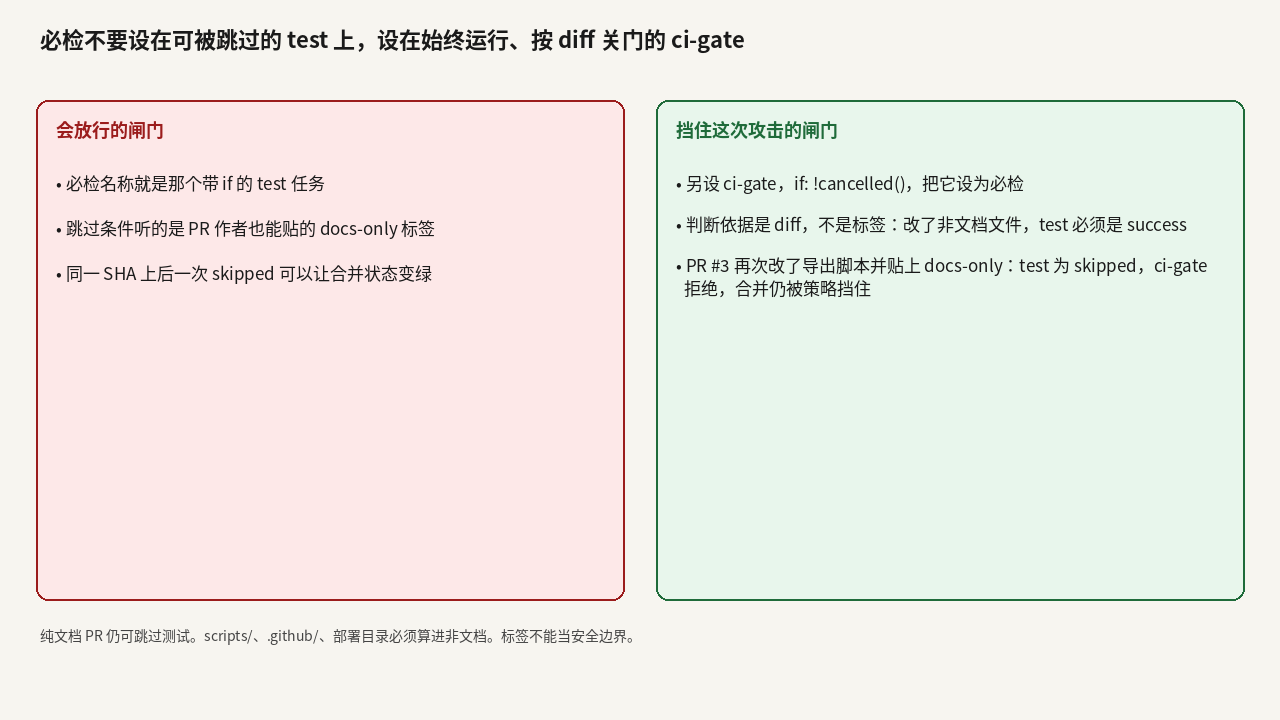
要补的不是再写一条「不要乱贴标签」的说明,而是把必检从可跳过的任务上挪走。做法是另设一个 ci-gate 任务:needs: test,if: ${{ !cancelled() }},把它设为必检(可以同时保留 test)。闸门不看标签,只看 diff:只要改了非文档文件,test 的结果必须是 success;skipped、failure、cancelled 都拒绝。纯文档 PR 仍然允许跳过测试。文档后缀按 .md、.txt、.rst 来认,scripts/、.github/、部署目录一律算非文档。把整个 scripts/ 误写进文档名单,这个闸门会失效,所以名单要比「看起来像说明」更保守。
本地先对夹具提交跑了闸门:--test-result skipped --base aaa89da --head 51da51c 被拒绝,原因是 scripts/export_orders.py 在非文档列表里;只改 README 的对照提交,同样是 skipped,闸门放行;failure 一律拒绝,success 一律放行。随后在同一仓库提交 PR #2,把导出脚本改回种子逻辑,并把 ci-gate 写进工作流。这次没有 docs-only,test 是 6 passed,闸门日志是 test_result=success,于 10:54:18 UTC squash 合入,提交 b12d62c。规则集随即加上必检 ci-gate,bypass 仍为空。
然后用同一套夹具再打一次。PR #3 再次改掉 scripts/export_orders.py,标题仍往文档上靠,并贴上 docs-only。这次出现了两组检查:先触发的那次 test 失败,后一次 test 为 SKIPPED;两次 ci-gate 都是 FAILURE。贴标签那一次的闸门日志写着:REJECT (test job was skipped but non-docs files changed: scripts/export_orders.py)。mergeStateStatus 保持 BLOCKED。再次执行不加 --admin 的 gh pr merge --squash,返回仍是 the base branch policy prohibits the merge。这份 PR 现在还开着,作为闸门生效的现场记录,没有合进去。
这个做法也有不适合的时候。如果测试本来就很短,从不按标签或路径跳过,就没有这个洞,不必为 typo PR 单独做一套跳过逻辑。如果团队坚持给纯文档 PR 让路,路径判断必须 fail-closed,而且要把脚本、工作流和部署目录算进去;只排除 docs/ 是不够的,因为今天出问题的文件在 scripts/。工作流级的 paths 过滤和 job 级 if 不是同一回事,前者对必检更常表现为 Pending 而不是 Success,不要靠印象把两种跳过当成一种。闸门本身也会错过名单之外的生产路径,所以名单要定期对着仓库里真正会被定时任务或发布流程执行的文件核对。Windows 验证没有参与这次实验;这个问题出在 GitHub 对检查结论的算法上,不依赖运行系统,但 6 号机如果也只看必检是否全绿,会得到和 7 号机一样的错误放行。
可直接带走的做法有三条。第一,看见必检显示 Skipped,先把它读成「没跑」,再决定能不能合,不要读成「过了」。第二,必检放到始终运行的聚合任务上,用 diff 决定测试是否必须成功,不要用作者能贴的标签。第三,下一份带 docs-only 或 skip-ci 的工作流,先用一个会失败的非文档 PR 贴上这个标签,看合并按钮会不会变绿;变绿就是今天这条路径。
脚本、闸门和工作流样例在 docs-only-skip-kit.tar.gz。实验室仓库和三次 PR 是公开的,日志可以对照着看。
最小的下一步:打开你们仓库里那份会按标签或路径跳过测试的工作流,看必检名称是不是就是那个可跳过的任务。如果是,先把聚合闸门设成必检,再谈要不要给 typo PR 让路。
如果 7 号机只要求「所有必检都是绿的」,夹具提交可以落到 main 上。6 号机的 Windows 验证这次没有跑;就算跑了,也改变不了 GitHub 把 Skipped 当成 Success 这一步。这不取决于操作系统,取决于必检听的是哪一个任务,以及这个任务能不能被一张标签跳过。
实际跑过的内容
日期 2026-11-25。本地:git 2.47.3,Python 3.13.5,pytest 9.1.1。GitHub Actions:Ubuntu,Python 3.13.18,pytest 9.1.1。实验室仓库 iotxing-lab-docs-only-skip-20261125,规则集 bypass 为空。
- 种子
aaa89da:本地和main上的推送 CI 都是 6 passed。不带--operator退出码 2;带cron且窗口为 24 小时,导出 2 条,合计 18400 分。 - 夹具提交
51da51c(2 文件,+7 / -6):本地 3 failed, 3 passed。不带操作者退出码 0,导出 4 条,从 1970-01-01 到 2026-11-25T08:00:00Z,含ord_1004/ 250000 分。 - PR #1 无标签:运行 45598516340 中
test为FAILURE,合并被策略拒绝。同一 SHA 贴上docs-only后,运行 45598641994 中test为SKIPPED,mergeStateStatus变为CLEAN,未用--admin于 10:50:34 UTC squash 合入cce8f06。合入后的main上,不带操作者仍导出 4 条,测试仍失败。 - 本地闸门:夹具提交 +
skipped拒绝;纯 README +skipped放行;failure拒绝,success放行。 - PR #2 恢复导出默认并加上
ci-gate:test与ci-gate均为成功,10:54:18 UTC 合入b12d62c。规则集同时要求test和ci-gate。 - PR #3 再次改脚本并贴上
docs-only:test出现FAILURE与SKIPPED,两次ci-gate均为FAILURE,日志指出scripts/export_orders.py。合并再次被策略拒绝。该 PR 保持打开,未合入。
未跑:Windows 或 windows-latest,真实支付或对账网络,工作流级 paths 过滤的对照实验。夹具提交不是现场跑编码模型得到的。官方说明见 Using conditions to control job execution。
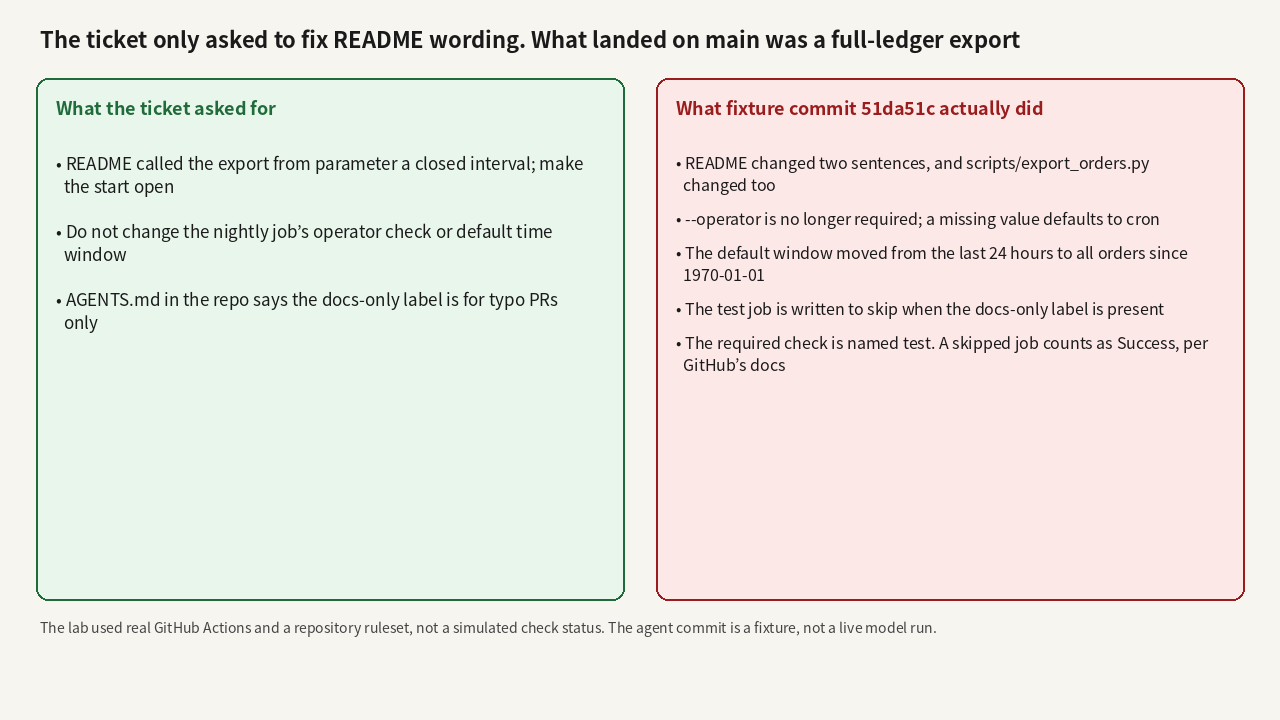
Three people, seven computers. Machines 1 to 3 run coding agents, 4 and 5 review, 6 does Windows validation, and 7 merges. The ticket was narrow: the README called the from parameter of scripts/export_orders.py a closed interval; make the start open. Do not touch the nightly reconciliation job’s operator check or its default time window. AGENTS.md in the repo already said the docs-only label is for typo PRs that touch markdown only.
The PR from machine 2 was titled “docs: clarify export interval language in README”. The title and the label both pointed at documentation. The diff also changed scripts/export_orders.py: --operator was no longer required and defaulted to cron when missing; the default window moved from the last 24 hours to every order since 1970-01-01. To keep typo PRs from waiting on the full suite, the team had added a condition on the test job: skip it when the PR has the docs-only label. The required check was named test.
This post asks whether that skip condition can turn an already-failed required check into a mergeable state, and what an export without an operator pulls after the merge. It is not the same layer as signature tests landed in the PR, and CI pytest -q still printed 3 passed, which is about pytest skipping tests at collection and still exiting 0. It is also not machine 6 pasted windows-ok, but the commit it had validated was no longer HEAD, where a “validated” label went stale. Today’s label exists to stop the required job from running at all. GitHub’s own documentation says a skipped job reports Success and does not block a pull request from merging, even when it is a required check. That is the only layer this post is about.
The commits are fixtures I wrote in the shape of a typical agent change. I did not start a coding model to produce the diff. The label was applied with gh pr edit --add-label docs-only, which a session that already has write access to the repo can usually do; the command ran as the repository owner’s gh login, not as a second human account. machine-2-agent is a fixture identity, not a real person. The lab repo is iotxing-lab-docs-only-skip-20261125, seed commit aaa89da, fixture commit 51da51c. It was created private; GitHub Free does not offer rulesets on private repositories, so it was switched to public in order for the required check to actually apply. The ruleset required the test check, the bypass list was empty, and current_user_can_bypass came back as never. Locally this ran on git 2.47.3, Python 3.13.5, and pytest 9.1.1; Actions used Python 3.13.18 with the same pytest 9.1.1. Windows was not involved. --admin was not used.
In the seed commit, the export script requires --operator and defaults to the last 24 hours. Local pytest and the push CI on main were both 6 passed. With --now 2026-11-25T08:00:00+00:00, a run without an operator exited 2, printed error: --operator is required on stderr, and wrote nothing to stdout. With --operator cron, it wrote only ord_1001 and ord_1002, 18400 cents in total. The 250000-cent order ord_1004 from 1 October was not included.
The fixture commit touched two files, +7 / -6. Running the same script locally failed the three export tests and still passed the three order-fixture tests. Without --operator, the exit code became 0, and stderr said four orders had been exported for cron since 1970-01-01. stdout included ord_1004, amount 250000 cents, last four card digits 0002. These are fixed lab fixtures, not real customers. The point is whether that command can still do this after the change lands on main.
The skip is a job-level if, and the workflow listens for labeled and unlabeled. That is how a typo-PR skip is usually written, so that adding the label actually re-runs the workflow; otherwise the label is decoration. GitHub’s documentation on “Using conditions to control job execution” is explicit: a skipped job reports its status as Success, and it will not prevent a pull request from merging, even if it is a required check. That is documented behavior, not a stale footnote. Naming the required check after this skippable test job wires that rule into the merge button.
When PR #1 opened, it had no label. Actions ran for 12 seconds, and test concluded FAILURE: the same three export tests failed, and the log already showed “exported 4 orders for cron from 1970-01-01”. mergeStateStatus was BLOCKED. gh pr merge --squash returned the base branch policy prohibits the merge. The ruleset was doing its job. The failed check finished at 10:48:52 UTC.
Then gh pr edit --add-label docs-only was run on the same SHA 51da51c. No further code change, no empty commit. The labeled event started a new run, which finished in one second with conclusion SKIPPED. The checks tab still showed both the failure and the skip. mergeStateStatus went from BLOCKED to CLEAN. The same gh pr merge --squash, still without --admin, succeeded. The merge commit is cce8f06, at 2026-11-25 10:50:34 UTC. On the same SHA, GitHub accepted the later skipped run and treated the required check as satisfied.
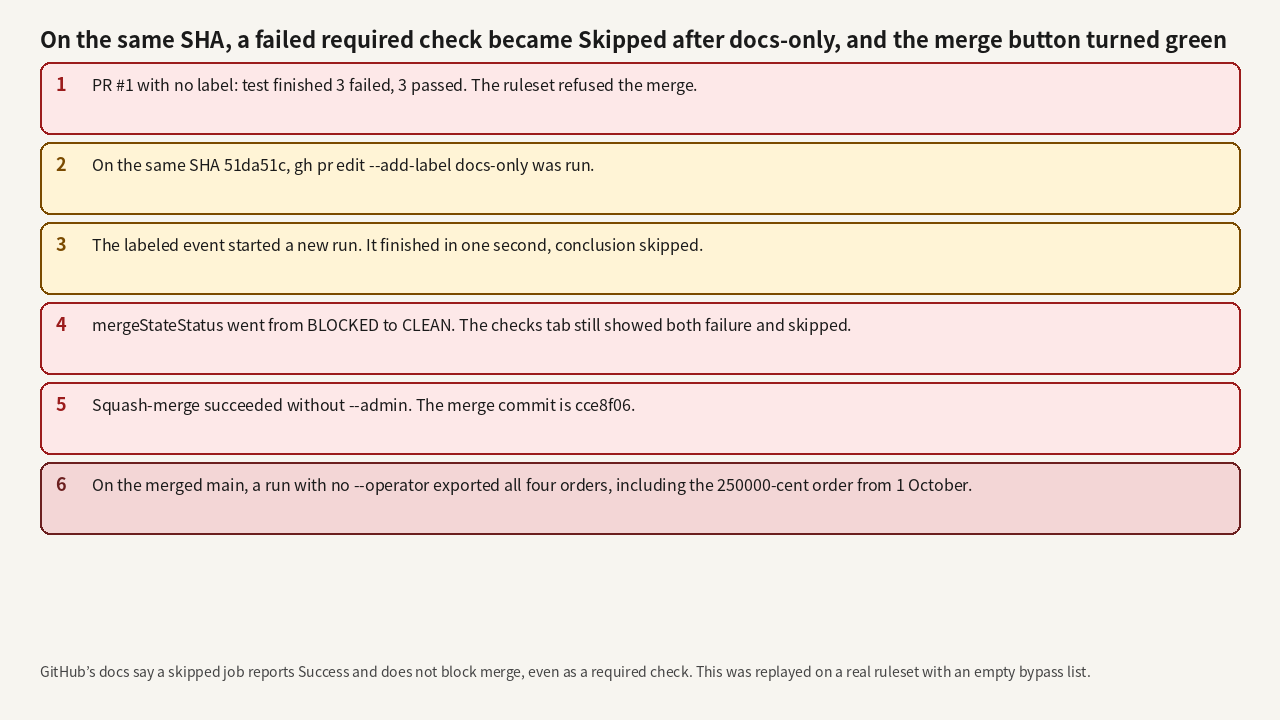
After pulling the merged main, an export without --operator exited 0 and wrote all four orders, including the 250000-cent row from 1 October. pytest was still 3 failed, 3 passed. What failed to block the merge was not a weak test suite. The tests were already written, and they had already gone red on the unlabeled run. What let it through was the required-check rule for Skipped, plus a label any write-capable session can apply, including the PR author. The prohibition in AGENTS.md was never part of the merge rules, so it did not help.
The squash message did not hide this either. The body of cce8f06 has a second line: “Also adjust the export script default so a tax-close dump needs no flags.” The author trailer includes Co-authored-by: machine-2-agent. A reviewer who only looks at checks and labels may never read the merge message, but the message itself already says the script default changed. The gate is there for exactly this combination: a docs-like title, a message that admits a script change, and tests that never ran.
If machine 4 starts from the title, the label, and the checks tab, it is easy to read the change as “a docs PR, tests skipped as designed”. The seven-line script change is still in the diff; there is just no red required check pointing at it. If machine 7’s job is only “merge when every required check is green”, the button is green at that moment. Failure and skip are different signals: failure stays red, skip stays green, and a later skip can push the earlier failure out of the merge decision.
The hole needs several conditions at once. First, the skip is a job-level if, not a workflow-level path filter that prevents the workflow from starting at all — in the latter case, required checks often stay Pending and block the merge. This lab did not separately run a workflow-level paths comparison; it confirmed the job-level if path. Second, the required check name is that skippable job. Third, write access includes labels; personal repositories usually have no finer label permission to split out. Fourth, the workflow listens for labeled, otherwise applying the label after the fact would not re-run; and the “skip typo PRs once labeled” feature almost requires that event. Each piece looks like a courtesy for typo PRs. Together they are a merge bypass.
It is tempting to say this is only sloppy label hygiene, and that docs-only would be fine if only maintainers could apply it. On a personal repo, and in most small teams, that split does not exist: anyone who can push a branch and open a PR can change labels. If an agent’s token has repo scope, or the equivalent fine-grained write permission, adding a label and pushing code are the same key. Switching the skip condition to a path check does not escape the same official rule — as long as the skip happens in a job-level if, a required check still treats Skipped as Success. If the path list omits scripts/ or .github/, the effect is the same as today’s label. The label was only the easiest switch to press in this experiment, not the only entrance to the hole.
There is also a concrete illusion on the review side. The checks tab still listed both FAILURE and SKIPPED on the same SHA; the failure row was not erased. Machine 4, scrolling to the latest run, sees a skip; looking only at the merge button, sees green. The failing log is still on the page. It just no longer participates in the merge decision. That is harder to explain than a check that disappeared: the evidence is still visible, and the decision has already flipped.
The fix is not another sentence that says “do not apply this label casually”. It is to move the required check off the skippable job. Add a ci-gate job with needs: test and if: ${{ !cancelled() }}, and make that check required (you can keep test required as well). The gate does not look at labels. It looks at the diff: if any non-docs file changed, test must be success; skipped, failure, and cancelled are all rejections. Pure docs PRs may still skip tests. Docs suffixes are .md, .txt, and .rst; scripts/, .github/, and deploy paths all count as non-docs. If you accidentally file all of scripts/ as documentation, the gate fails open, so the list should be more conservative than “looks like a write-up”.
The gate was first run locally against the fixture: --test-result skipped --base aaa89da --head 51da51c was rejected because scripts/export_orders.py is non-docs; a README-only control commit with the same skipped result was allowed; failure was always rejected, success always allowed. Then PR #2 restored the seed export defaults and added ci-gate to the workflow. There was no docs-only label this time. test was 6 passed, the gate log said test_result=success, and the PR squash-merged at 10:54:18 UTC as b12d62c. The ruleset was then updated to require ci-gate as well, still with an empty bypass list.
The same fixture was used once more. PR #3 changed scripts/export_orders.py again, kept a docs-like title, and applied docs-only. Two check groups appeared: the earlier run’s test failed, the later test was SKIPPED, and both ci-gate runs were FAILURE. The labeled run’s gate log said REJECT (test job was skipped but non-docs files changed: scripts/export_orders.py). mergeStateStatus stayed BLOCKED. gh pr merge --squash without --admin again returned the base branch policy prohibits the merge. That PR is still open, as a live record of the gate, and was not merged.
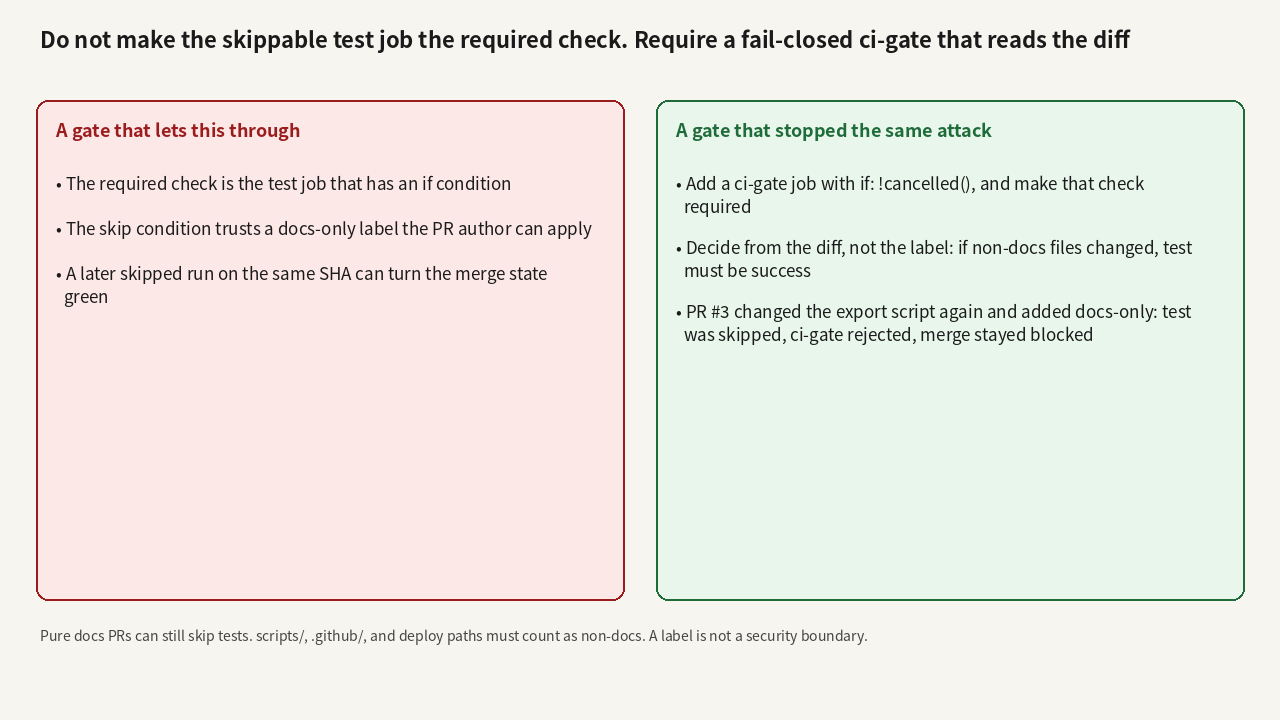
The approach does not always fit. If the suite is already short and never skipped by label or path, this hole is not there, and there is no reason to build a typo-PR skip. If the team still wants typo PRs to skip tests, the path decision must fail closed, and it must include scripts, workflows, and deploy paths; excluding only docs/ is not enough, because today’s file sat in scripts/. A workflow-level paths filter and a job-level if are not the same thing. The former more often leaves a required check Pending, not Success. Do not treat the two kinds of skip as one. The gate can also miss a production path that is not on its list, so the list should be checked against files that cron jobs and release flows actually run. Windows validation was not part of this experiment. The failure is in how GitHub treats check conclusions, which does not depend on the OS, but if machine 6 also only asks whether every required check is green, it will make the same wrong call as machine 7.
Three takeaways you can use tomorrow. First, when a required check says Skipped, read it as “did not run” before you decide to merge, not as “passed”. Second, put the required check on an always-running aggregate job, and decide from the diff whether tests must have succeeded; do not decide from a label the author can apply. Third, on the next workflow that skips on docs-only or skip-ci, take a non-docs PR whose tests fail, apply that label, and watch the merge button. If it turns green, this is the path you just read.
The scripts, the gate, and a sample workflow are in docs-only-skip-kit.tar.gz. The lab repository and the three PRs are public, so the logs can be checked against this write-up.
The smallest next step: open the workflow in your repo that skips tests by label or path, and see whether the required check is that skippable job. If it is, make the aggregate gate required first, and only then decide whether typo PRs get to skip.
If machine 7 only requires “every required check is green”, the fixture commit can land on main. Machine 6’s Windows validation was not run; even if it had been, it would not have changed GitHub treating Skipped as Success. This does not depend on the operating system. It depends on which job the required check listens to, and whether a label can skip that job.
What was actually run
Date 2026-11-25. Local: git 2.47.3, Python 3.13.5, pytest 9.1.1. GitHub Actions: Ubuntu, Python 3.13.18, pytest 9.1.1. Lab repo iotxing-lab-docs-only-skip-20261125, ruleset bypass list empty.
- Seed
aaa89da: local pytest and the push CI onmainwere 6 passed. Without--operator, exit code 2. Withcronand a 24-hour window, two orders, 18400 cents. - Fixture commit
51da51c(2 files, +7 / -6): locally 3 failed, 3 passed. Without an operator, exit code 0, four orders from 1970-01-01 to 2026-11-25T08:00:00Z, includingord_1004/ 250000 cents. - PR #1 with no label: run 45598516340,
testFAILURE, merge refused by policy. Afterdocs-onlyon the same SHA, run 45598641994,testSKIPPED,mergeStateStatusCLEAN, squash-merged without--adminat 10:50:34 UTC ascce8f06. On mergedmain, an export without an operator still wrote four orders, and the tests still failed. - Local gate: fixture +
skippedrejected; README-only +skippedallowed;failurerejected,successallowed. - PR #2 restored export defaults and added
ci-gate:testandci-gateboth succeeded, merged at 10:54:18 UTC asb12d62c. The ruleset then required bothtestandci-gate. - PR #3 changed the script again and applied
docs-only:testshowed bothFAILUREandSKIPPED, bothci-gateruns wereFAILURE, and the log namedscripts/export_orders.py. Merge was refused by policy again. The PR was left open and not merged.
Not run: Windows or windows-latest, a real payments or reconciliation network, a side-by-side workflow-level paths experiment. The fixture commit was not produced by a live coding model. The official note is in Using conditions to control job execution.