绿勾 agent PR 正在悄悄杀死审查文化。
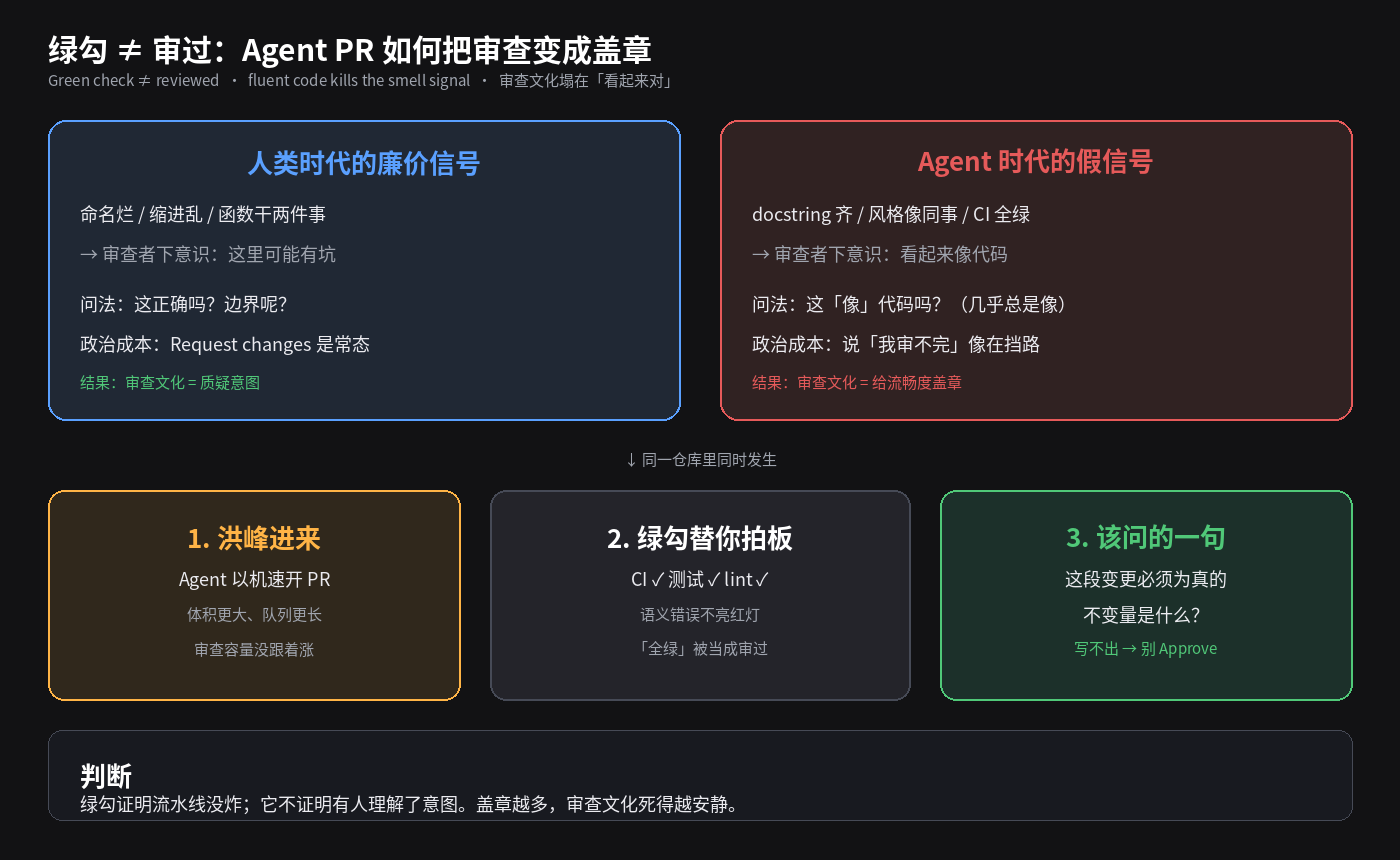
我不是在骂模型写得烂。我骂的是:当 diff 看起来永远「像一位细心同事」时,审查者开始问「这像代码吗」,而不再问「这正确吗」。答案几乎总是像。于是 Approve 变成盖章,绿勾变成替身裁判。
数据先把体面撕开
CodeRabbit 对 470 个开源 PR 的对照(320 个 AI 共著、150 个人工)给出硬数:AI 侧平均 10.83 个问题 / PR,人工侧 6.45,约 1.7×;逻辑与正确性问题高 75%。更糟的是:可读性问题飙到 3× 以上——模型把「看起来整齐」和「真的对」拆开了。审查启发式过去靠烂命名、乱缩进当廉价风险探针;探针坏了,人就滑向「看起来没问题」。
LinearB 2026 基准用 810 万+ PR 把瓶颈钉在审查侧:AI PR 30 天内合并率 32.7%,人工 84.4%;AI-assisted PR 的 P75 体积约 408 行,无人辅助约 157 行。Agentic PR 等着被捡起的时间更长(P75 约 17.6 小时 vs 3.4),一旦有人打开,审查却往往更快扫过。队列变长、体积变大、扫视变浅——这就是盖章的温床,不是「模型突然变好了」。
Tian 的「橡皮图章式崩溃」把机制说透:超过大约 400 行,审查者不是在审,是在抽样;诚实说「我审不完」有政治成本,四分钟盖章没有。语义错误——错列、吞掉重试依赖的异常、N+1——在 diff 里长得像普通正确代码。CI 全绿只证明流水线没炸,不证明有人理解了意图。
中国团队更熟的那个场面
我不需要你信某一家的榜。你只要回想周会上那句:「CI 都绿了,先合吧,晚上再看。」Agent 一开,这句话从例外变成默认。群里转发的 demo 永远是:模型写完、测试绿、一键合并。没人转发的是:评审评论密度掉了、回滚里 AI 占比悄悄升了、新人不再被教「怎么质疑意图」,只被教「怎么让流水线变绿」。
审查文化死法很安静。它不是某一天取消 Code Review;它是评论从「这段不变量是什么」退化成「import 顺序」「变量名再短一点」。绿勾越多,质疑越贵,盖章越便宜。
今晚只做一件事
挑一个你本周准备 Approve 的 agent PR。在点绿勾之前,先在评论里写下一句:「这段变更必须始终为真的不变量是 ___。」写不出来——Request changes,别用「晚上再看」给自己找台阶。
绿勾证明流水线没炸。它不证明有人理解了意图。盖章越多,审查文化死得越安静。
Green-check agent PRs are quietly killing review culture.
I am not saying the models write garbage. I am saying: once every diff looks like a careful teammate wrote it, reviewers stop asking “is this correct?” and start asking “does this look like code?” The answer is almost always yes. Approve becomes a stamp. The green check becomes a substitute judge.
The numbers rip the polite story open
CodeRabbit’s study of 470 open-source PRs (320 AI-coauthored, 150 human-only) puts hard counts on the table: 10.83 issues per AI PR versus 6.45 for human — about 1.7× — with logic and correctness issues up 75%. Worse: readability findings jump more than 3×. The model splits “looks tidy” from “is actually right.” Old review heuristics used messy names and bad indentation as cheap risk probes. The probe broke. People slide into “looks fine.”
LinearB’s 2026 benchmarks across 8.1M+ PRs pin the bottleneck on review: AI PRs merge within 30 days at 32.7% versus 84.4% for unassisted work; AI-assisted P75 size lands near 408 lines versus 157. Agentic PRs wait longer to be picked up (P75 ~17.6 hours vs 3.4), then often get a faster skim once opened. Longer queues, bigger diffs, shallower scans — that is the rubber-stamp greenhouse, not “the model suddenly got trustworthy.”
Tian’s “Rubber-Stamp Collapse” names the mechanism: past roughly 400 lines, reviewers are sampling, not reviewing. Saying “I cannot finish this honestly” has political cost; a four-minute approve does not. Semantic bugs — wrong column, swallowed retry exceptions, N+1 — look like ordinary plausible code in the diff. All-green CI proves the pipeline did not explode. It does not prove anyone understood the intent.
The scene Chinese teams already know
You do not need to worship any vendor chart. Just replay the standup line: “CI is green — merge first, we’ll look tonight.” Once agents open PRs, that line stops being the exception and becomes the default. The demos that get forwarded are always: model finished, tests green, one-click merge. What never gets forwarded: comment density falling, AI share creeping into rollbacks, juniors taught how to make the pipeline green instead of how to challenge intent.
Review culture dies quietly. Nobody cancels Code Review in one meeting. Comments degrade from “what invariant must stay true?” into “import order” and “shorter variable name.” More green checks make questioning expensive and stamping cheap.
One move tonight
Pick one agent PR you were about to Approve this week. Before the green button, write one review comment: “The invariant that must stay true for this change is ___.” If you cannot fill the blank — Request changes. Do not buy yourself a night with “we’ll look later.”
A green check proves the pipeline did not blow up. It does not prove anyone understood the intent. The more you stamp, the quieter review culture dies.