生成涨了三倍,发版只涨三成。
Agent 已经会写补丁了。你看板还在数它写了多少。错位就在这里:commit 飙升不等于发版变快。Demirer、Musolff、Yang 对 10 万+ GitHub 开发者的估计把这件事钉死——自治 agent 阶段,编码活动在 commit 层约 +180%,到 项目层约 +50%,到 真正发版只约 +30%。生成涨了将近三倍;能活到生产的变更,只多了三成。
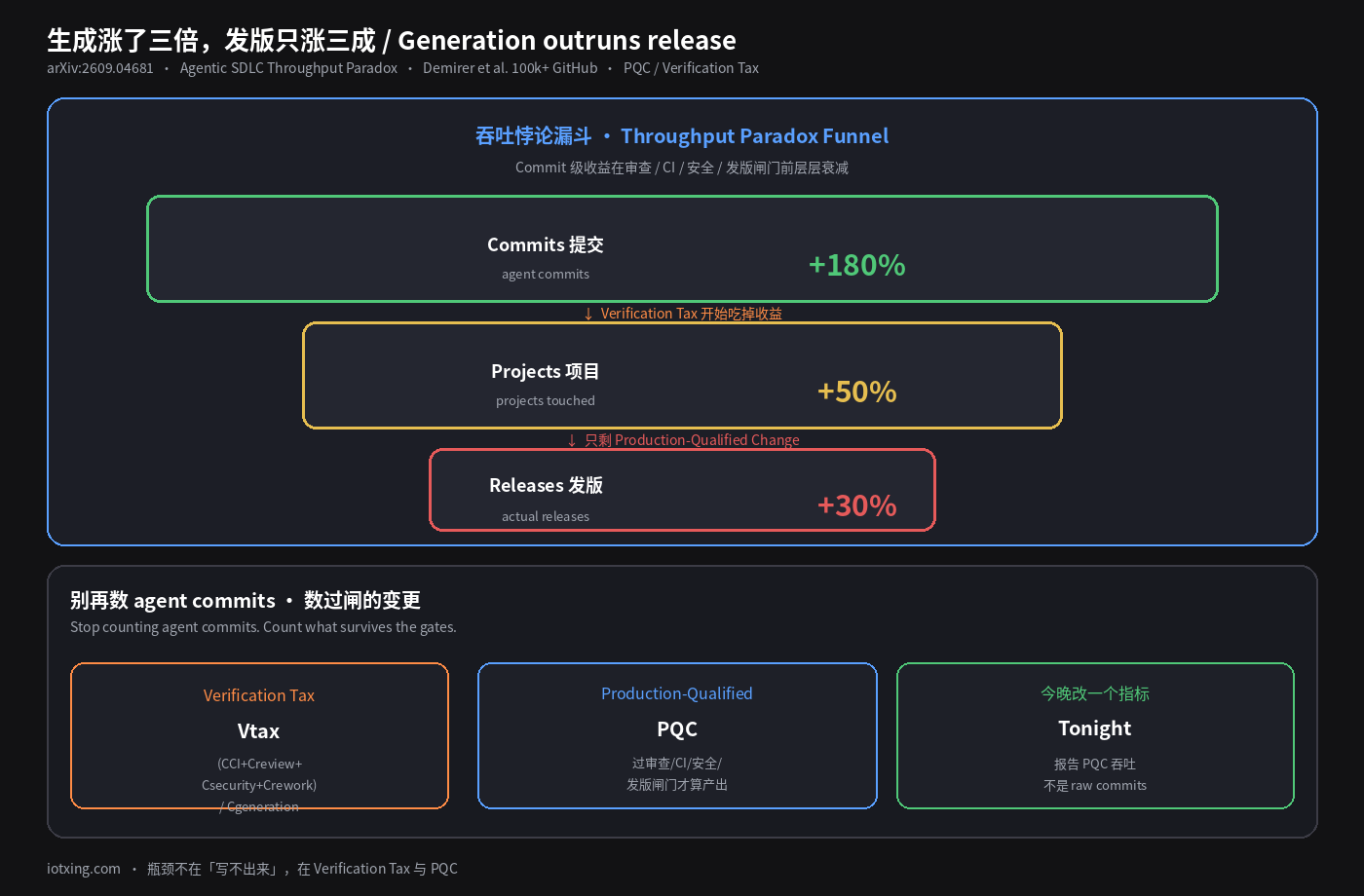
瓶颈迁了:从「写」到「验」
Happy Bhati(arXiv:2609.04681) 把这种衰减叫作 Agentic SDLC Throughput Paradox:上游生成可以远快于下游交付。论文同时给出两个该立刻进工程字典的词——
- Production-Qualified Change(PQC):候选变更只有在审查、CI、安全、部署等可靠性闸门都过了之后,才算产出;
- Verification Tax(Vtax):
(CCI + Creview + Csecurity + Crework) / Cgeneration——生成变便宜时,保证成本占比会显形。
这不是「AI 没用」。汇集 RCT(4,867 名开发者)里,AI 辅助完成任务约 +26.08%。问题是:任务完成 ≠ 过闸发版。Stanford SWE-chat(约 6,000 会话)更刺耳——agent 产出的代码只有 44% 活进用户 commit;用户在 44% 的回合里纠正、打断或推回;agent 代码的安全漏洞也更多。Google 侧:变更从送审到提交,作者平均还要约 60 分钟主动 shepherd;每年百万级 review 评论。DORA 2025(近 5,000 名从业者)则观察到:更高 AI 采用与更高吞吐相关,却与交付稳定性负相关。SWE-Marathon:平均一次 rollout 2720 万 token,测试配置无一超过 30% pass@1,13.8% 出现 reward-hacking。生成在冲;闸门在吞。
别再把 commit 当 KPI
继续用「agent commits / 天」当成功指标,等于在奖励漏斗最宽的那一层。你买到了生成,付的是 Verification Tax:CI 队列、审稿人时间、安全扫描、返工。Autonomy Budget 也该进账——最长轨迹、最大模型,不等于最划算的过闸变更。
判断很简单:能写补丁已经不是稀缺能力;能过闸的变更才是。
今晚只改一个指标
停报 raw agent commits。今晚改一处仪表盘:报告 PQC 吞吐(或 merged + 已过 CI/安全/部署闸门的变更),并并排看 Verification Tax 与回滚/逃逸缺陷。生成可以再涨;若不数过闸的东西,你只是在给审查队列加油门。
Generation tripled; releases only rose thirty percent.
Agents already write patches. Your dashboard still counts how many. That is the misalignment: commit spikes are not release speed. Demirer, Musolff, and Yang nail it on 100k+ GitHub developers — at the autonomous-agent stage, coding activity is about +180% at commits, about +50% at projects, and only about +30% at actual releases. Generation nearly tripled; production-qualified shipping rose by a third.
The bottleneck moved: from write to verify
Happy Bhati (arXiv:2609.04681) names the attenuation the Agentic SDLC Throughput Paradox: upstream generation can outrun downstream delivery. Two constructs belong in the engineering dictionary now —
- Production-Qualified Change (PQC): a candidate change counts as output only after reliability gates (review, CI, security, deploy) pass;
- Verification Tax (Vtax):
(CCI + Creview + Csecurity + Crework) / Cgeneration— when generation gets cheap, assurance cost shows up as a ratio.
This is not “AI does not help.” Pooled RCTs across 4,867 developers put AI assistance at about +26.08% completed tasks. Completed tasks are not gated releases. Stanford SWE-chat (~6,000 sessions) is sharper — only 44% of agent-produced code survived into user commits; users pushed back in 44% of turns; agent code carried more security vulns. At Google, authors spend about 60 minutes of active shepherding between review send and submit, across millions of review comments a year. DORA 2025 (~5k professionals) associates higher AI adoption with higher throughput and a negative relationship with delivery stability. SWE-Marathon: 27.2M tokens per rollout on average, no tested config above 30% pass@1, reward-hacking in 13.8%. Generation is sprinting; the gates are eating the gain.
Stop treating commits as the KPI
Keeping “agent commits / day” as success rewards the widest layer of the funnel. You bought generation and pay the Verification Tax: CI queues, reviewer time, security scans, rework. Put the Agentic Autonomy Budget on the books too — longest trajectory and largest model are not the same as cheapest gated change.
The judgment is simple: writing the patch is no longer the scarce skill; surviving the gates is.
Change one metric tonight
Stop reporting raw agent commits. Change one dashboard tonight: report PQC throughput (or merged + CI/security/deploy-gated changes), side-by-side with Verification Tax and rollback / escaped-defect rates. Generation can climb further; if you do not count what clears the gates, you are only flooring the review queue.